If you’re running a course, coaching program, or digital product business, you’ve probably experienced the launch rollercoaster. The adrenaline rush of an open-close cart campaign, the scramble to get everything ready, the exhausting email sequences… and then the crash when it’s over and revenue drops to zero until the next launch.
There’s a better way.
An evergreen funnel lets you do the work of setting up a launch once, then run it continuously in the background. Instead of opening and closing the cart for everyone at the same date and time, an evergreen funnel creates a unique deadline for each person who enters — meaning you can drive consistent customers every single day without burning out.
In this guide, I’ll walk you through exactly how to build an evergreen funnel that actually converts, using a real example from a funnel that’s currently running and driving daily revenue. You’ll see the specific components you need, how they work together, and the testing strategies that separate funnels that convert from ones that just… sit there.
What Is an Evergreen Funnel?
An evergreen funnel is an automated sales process that creates urgency through individualized deadlines rather than calendar-based dates. When someone enters your funnel, a countdown timer starts that’s unique to them — not tied to when everyone else is seeing the offer.
There are two main launch models:
Open cart/close cart: Everyone sees the same deadline. The cart opens on Monday at 9am, closes Friday at midnight. If you run this launch, everyone who’s interested has until Friday to make a decision. Then it’s over, and you start planning the next one.
Evergreen funnel: Each person gets their own deadline. Sarah enters the funnel on Monday and has until Saturday. Tom enters on Wednesday and has until the following Tuesday. The funnel is always “open” to new people, but each individual experiences real scarcity and urgency.
This approach works particularly well for:
- Course creators who want consistent enrollments
- Coaches selling group programs or masterminds
- Digital product sellers (templates, tools, membership sites)
- SaaS companies with self-serve onboarding
It’s less ideal for:
- High-touch custom services where you need to personally qualify everyone
- Seasonal or time-sensitive products
- Launches where live elements (like Q&A sessions or cohort starts) are part of the value
The core appeal is simple: you build the machine once, and it runs continuously. No more feast-or-famine revenue cycles.
The 5 Essential Components of an Evergreen Funnel
Every successful evergreen funnel needs these five pieces working together:
1. Traffic Source
You need a consistent stream of new people entering the funnel. This could be paid ads (Facebook, Instagram, Google), organic traffic from SEO or content marketing, partnerships, or a combination. The key word is “consistent” — if traffic is sporadic, your evergreen funnel won’t generate reliable results.
2. Entry Point
This is how people first engage with your offer. Common entry points include:
- A webinar (live or automated)
- A free challenge or email course
- A lead magnet that leads into a sales sequence
- A video series that builds to an offer
- Direct-to-offer landing page (for warm traffic)
Your entry point should provide genuine value while naturally leading toward your paid offer.
3. Email Nurture Sequence
The bridge between your entry point and your offer. These emails warm up prospects, overcome objections, share social proof, and create urgency around the deadline. The sequence runs on autopilot but should feel personal and timely.
4. Special Offer Page
This is your sales page with a time-sensitive offer displayed via an evergreen countdown timer. The countdown creates urgency by showing prospects exactly how much time they have left to take advantage of your special pricing, bonuses, or limited-time offer.
5. Redirect Strategy
What happens when the countdown expires? You need a plan. Most successful evergreen funnels redirect visitors to either:
- A full-price offer page (same product, higher price or fewer bonuses)
- A waitlist page (if you want true scarcity)
- A closed page (for high-ticket offers where you want to protect exclusivity)
The key is that your deadline must be real. If people can still get the special offer after the timer expires, you’ve trained them that there’s no actual urgency.
Step-by-Step: Building Your Evergreen Funnel
Let’s break down exactly how to build each component. I’ll reference a real working funnel throughout (Davey & Krista’s AI newsletter funnel that converts daily) so you can see how theory meets practice.
Step 1: Choose Your Entry Point
Your entry point needs to accomplish two things: provide genuine value and naturally lead to your paid offer. The most common entry points for evergreen funnels are:
Webinars: Work well for higher-ticket offers ($500+) where you need to overcome objections and build trust. Can be live the first time, then automated.
Email courses: Great for lower-ticket offers where the value is in the education itself. Usually 3-7 days of emails that lead to an offer.
Lead magnets → Sales sequence: Quick-win resources (checklists, templates, mini-courses) that get people on your list, then a targeted email sequence that pitches the offer.
Video series: Similar to webinars but broken into shorter segments. Can feel more consumable for busy audiences.
Direct-to-offer: Works if you have warm traffic (retargeting, existing audience, referrals) who already trust you.
Real example: The AI newsletter funnel uses a webinar about showing up in AI search results. People register for the webinar (which is now automated), watch it or don’t, and then receive a series of follow-up emails promoting a special offer on the paid newsletter.
Here’s something worth testing: Do you actually need the webinar? If you launched with one and it converted well, you might be attached to it. But consider testing a direct-to-offer approach where you skip the webinar and drive people straight to the special offer page. This shortens your funnel and decreases the time between ad spend and revenue. The webinar might be creating value, or it might just be creating delay.
Step 2: Set Up Your Sales Pages
You’ll need two versions of your sales page:
Special offer page: This is your time-limited offer with better pricing, exclusive bonuses, or both. It must include an evergreen countdown timer that shows each visitor their unique deadline.
Standard offer page: Same product, but without the special offer. This could mean:
- Higher price
- Fewer bonuses included
- Quarterly payment plan instead of monthly
- Access to recent content only (not the full library)
The critical thing to understand: these need to be two separate pages, not one page where you hide/show elements with code. Why? Because when the countdown expires on the special offer page, you’ll redirect visitors to the standard offer page. This ensures they can’t manipulate the timer or bookmark their way back to the deal.
Real example: Davey & Krista’s funnel has two URLs:
- Special offer:
daveyandkrista.com/design-edit/offer(50% off monthly subscription) - Standard offer:
daveyandkrista.com/design-edit(quarterly and annual options only, no monthly)
The pages are nearly identical in design and copy — the only difference is the countdown timer bar at the top of the special offer page and the pricing/payment options at the bottom.

Step 3: Implement Your Countdown Timer
This is where most evergreen funnels either succeed or fail. You need a countdown timer with three specific capabilities:
1. Unique countdown per visitor: The timer must start when someone first lands on the page, not at a fixed time. If Sarah visits on Monday and Tom visits on Wednesday, they should see different countdowns.
2. Automatic redirect when expired: When time runs out, the special offer page should automatically redirect to your standard offer page. No manual intervention, no loopholes.
3. Display rules for specific pages: The timer should only appear on your special offer page, not site-wide.
Here’s how to set this up with BDOW!:
BDOW!’s countdown timer feature gives you both “evergreen” and “fixed date” options. For an evergreen funnel, you’ll select the evergreen option, which creates a unique countdown for each visitor based on when they first land on the page.
When configuring your countdown timer:
- Choose the countdown duration (more on timing in Step 4)
- Set what happens when it expires — select “redirect to another page” and enter your standard offer URL
- Under display rules, specify that the timer should only show on your special offer page URL

The timer can be displayed as a top-of-page bar (called a “smart bar” in BDOW!), embedded in your page content, or as a modal. The smart bar works particularly well because it’s visible throughout the entire page experience without interrupting the reading flow.
[Note: Include screenshot of BDOW! countdown settings panel with evergreen options highlighted]
Common countdown timer mistakes to avoid:
Using a timer that restarts when it expires doesn’t necessarily kill your credibility immediately, but you do run the risk of training your audience that there’s actually no urgency. If they discover the offer is still available after the deadline, or worse — if the timer just resets and starts over — you’ve taught them to ignore all future deadlines.
The best practice: when you tell someone they have a limited time to decide, make that actually true. Redirect them to a different offer (or no offer) when time runs out.
For more details on setting up BDOW!’s countdown timer, check out this help article and this video walkthrough.
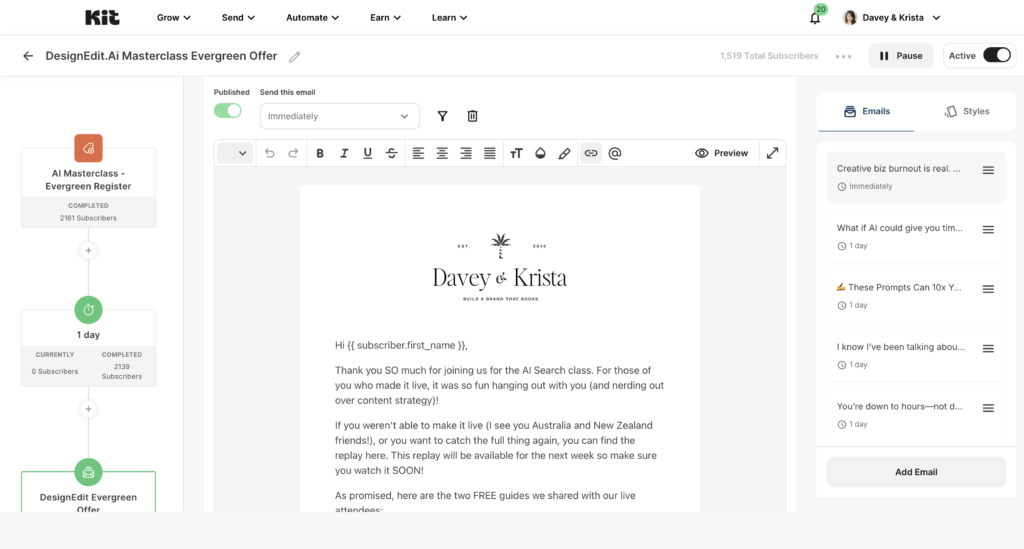
Step 4: Build Your Email Sequence
Your email sequence is the nurture bridge between your entry point and your offer. It should accomplish several goals:
- Reinforce the value they got from your entry point
- Share social proof and success stories
- Address common objections
- Create urgency around the deadline
- Remind them of what they’ll lose if they don’t act
How long should the sequence (and countdown) last?
This is not an exact science, and you should absolutely test different durations. But here are starting ranges based on price point:
- Under $100 products: Less than 3 days
At lower price points, people don’t need a week to make a decision. A shorter funnel often converts better because it forces action before overthinking sets in. - $100-500 products: 3-7 days
This middle range benefits from a bit more nurture. You have time to share multiple case studies, address different objections, and let people sit with the decision. - $500+ products/courses: 5+ days
Higher-ticket offers typically need more time. People need to justify the investment, talk to a partner, check their budget. Seven days is common, though some funnels extend to 14 days for very high-ticket offers.
Real example: The AI newsletter funnel runs for 7 days. For a product that costs $10/month or $99/year, that’s actually quite long. It works because there’s a robust email sequence with multiple touchpoints, but there’s definitely room to test a 3-day or 5-day version to see if conversion rates improve with more urgency.
What they’re currently testing:
- Shortening the funnel to 5 days
- Adding quarterly vs annual pricing options on the standard offer page
- Restricting access to the newsletter archive for monthly subscribers (only annual subscribers get the full library)
The email sequence should match the countdown duration. If your special offer expires in 5 days, your email sequence should also run for 5 days, with the final email landing right before the deadline expires.
Common email sequence structure:
- Email 1 (right after entry point): Thank them, deliver on any promises, tease what’s coming
- Email 2-3 (middle of sequence): Share social proof, address objections, highlight specific benefits
- Final 2 emails: Strong urgency, remind them of the deadline, make the ask clear
Step 5: Drive Traffic to Your Funnel
An evergreen funnel is only as good as the traffic flowing into it. The most effective traffic source for evergreen funnels is paid ads because they provide consistent, predictable volume.
Why paid ads work well for evergreen:
- You control the volume (spend more, get more leads)
- You can target cold audiences who don’t know you yet
- You can optimize based on actual conversion data
- It’s predictable enough to forecast revenue
Other traffic sources that can work:
- SEO and organic content (but requires significant existing traffic)
- Partnerships and affiliates (if you have the relationships)
- Social media (though algorithms make consistency challenging)
- Retargeting existing audience members

The key is consistency. If you’re only getting a few people per week entering your funnel, it’s hard to know if your conversion problems are traffic quality issues or funnel issues. You need enough volume to make meaningful optimizations.
Real example: Davey & Krista run Facebook ads directly to the webinar registration page. You can see their active ads in the Facebook Ad Library by searching for their business name. The ads focus on the promise of the webinar (showing up in AI search results) rather than selling the newsletter directly.
[Note: Include screenshot of example Facebook ad or ad library search]
Real Example: Breaking Down a Working Evergreen Funnel
Let’s look at exactly how Davey & Krista’s AI newsletter funnel works from start to finish:
The Complete Flow:
- Ad → Webinar registration: Facebook ads drive people to a masterclass about AI search. The registration page shows upcoming webinar times (always scheduled at regular intervals like “10 minutes from now,” “tomorrow,” “in 2 days”).
- Webinar delivery: Registered attendees receive reminder emails to attend. The webinar is now automated (it was live the first time) and provides genuine value about showing up in AI-generated search results.
- Post-webinar email sequence: Regardless of whether someone attends the webinar, they enter a 7-day email sequence that promotes the special offer on the paid newsletter.
- Special offer page: When someone clicks through from an email, they land on
daveyandkrista.com/design-edit/offerand see a countdown timer offering 50% off the monthly subscription. The countdown is unique to them — it started when they first landed on that page and runs for 7 days. - The redirect: When the countdown expires, anyone who visits the special offer page gets automatically redirected to
daveyandkrista.com/design-edit— the standard pricing page with quarterly and annual options (no monthly option, no 50% discount).
What makes it work:
The offer legitimately expires. If you miss the 7-day window, you can still subscribe to the newsletter, but you pay the standard price. This creates real urgency without false scarcity.
The funnel has been running for months and drives customers every single day. Not huge numbers (it’s a $10-99/year newsletter, after all), but consistent, predictable revenue that compounds over time.
What they’re testing:
- Funnel duration: Is 7 days too long for a low-ticket offer? Would 3-5 days force faster decisions and improve conversion rates?
- Pricing tiers: Does offering quarterly vs annual pricing on the standard page impact conversions? Do people need that monthly option, or is annual actually more attractive when positioned correctly?
- Bonus structure: Right now, all subscribers get access to the full newsletter archive. They’re testing restricting the archive to annual subscribers only, making the annual plan more valuable without changing the base price.
- The webinar itself: Would skipping the webinar and driving people directly to the offer page shorten the conversion cycle? The webinar converted well in the live launch, but is it still necessary in the evergreen format?
This is the key to successful evergreen funnels: they’re never “done.” You launch, you measure, you test, you iterate.
Common Evergreen Funnel Mistakes to Avoid
1. Not matching funnel length to offer price
This shows up in two ways: giving people a week to decide on a $27 product (too long, they’ll overthink and abandon), or giving them 2 days to decide on a $2,000 program (too short, they need time to process).
The solution is testing different durations within the ranges mentioned earlier, but pay attention to when people actually convert. If most sales happen in the first 48 hours of a 7-day funnel, you might be unnecessarily delaying revenue.
2. Confusing price with offer
Your “special offer” doesn’t have to be a discount. It could be:
- Same price but with additional bonuses
- Same price but with better payment terms (monthly vs quarterly)
- Same price but with exclusive access (like the newsletter archive example)
- Same price but with implementation support or coaching calls
A strong offer is about value, not just price. Sometimes adding bonuses that cost you little (templates, swipe files, recordings of past trainings) creates more urgency than a 20% discount.
3. Not having a post-deadline option
Unless you’re running true scarcity (limited cohort, for instance), completely closing the offer after the countdown expires usually just leaves money on the table. People talk themselves into buying at weird times. If they miss your deadline but come back a week later ready to buy… let them buy. Just not at the special offer price.
The redirect strategy solves this: special offer page → standard offer page. You maintain urgency (the deal is gone) without turning away interested buyers.
4. Neglecting the email sequence
Your countdown timer creates urgency, but your email sequence creates desire. Don’t just send “reminder: 3 days left!” emails. Use the sequence to share success stories, overcome objections, highlight specific use cases, and remind people of the transformation your offer provides.
The timer tells them “when” to decide. Your emails tell them “why” to say yes.
5. Not testing and iterating
Your first version of the funnel won’t be your best version. Track these metrics:
- Entry point conversion rate (how many people sign up for webinar/download lead magnet)
- Email open and click rates
- Offer page conversion rate
- Time-to-purchase (when in the countdown do people actually buy?)
- Overall funnel conversion rate (traffic → customer)
Then run tests:
- Different email subject lines and send times
- Shorter vs longer countdown durations
- Various bonus structures
- Different entry points
- Price points and payment options
Small improvements across multiple parts of the funnel compound into significant revenue increases.
Should You Use an Evergreen Funnel?
Evergreen funnels work exceptionally well for:
Course creators and coaches who want consistent enrollments without the boom-bust cycle of live launches. If you have a proven course or program that sells well during launches, an evergreen version lets you keep that revenue flowing between big promotional pushes.
Digital product sellers offering templates, tools, membership sites, or other self-serve products. The automated nature of delivery makes evergreen ideal.
SaaS companies with self-service onboarding where customers can sign up and start using the product without hand-holding. The evergreen funnel becomes your automated sales team.
They’re less ideal for:
High-touch service providers who need to personally qualify leads and customize solutions. You can still use evergreen funnels to generate leads, but the “close cart” pressure doesn’t work the same way when you’re selling custom implementation.
Seasonal or time-sensitive products where the value is tied to specific dates (tax prep, holiday planning, event-based coaching).
Launches where live elements add significant value — like cohort-based courses where community interaction is part of the experience, or programs where live Q&A sessions are a major selling point.
The hybrid approach: Many successful businesses run both evergreen funnels AND periodic live launches. The evergreen funnel provides baseline revenue and keeps the pipeline full. Then 2-4 times per year, you run a big live launch with updated content, live training, or exclusive bonuses. This combines the consistency of evergreen with the revenue spikes and excitement of live launches.
Start Building Your Evergreen Funnel
If you’re ready to move away from the feast-or-famine launch cycle, here’s how to start:
Begin with one proven offer. Don’t try to evergreen-ify everything at once. Pick your best-converting product or program and build the funnel around that.
Keep it simple initially. You don’t need a 90-day webinar series and 47 emails. Start with a solid entry point, a tight 5-7 email sequence, and a clear offer with a real deadline.
Set up your countdown timer correctly. This is the linchpin. If the timer doesn’t work properly, the whole funnel falls apart. Use a tool like BDOW! that handles the technical complexity (unique countdowns per visitor, automatic redirects, display rules) so you can focus on the marketing.
Drive consistent traffic. Even a perfectly optimized funnel can’t work without people entering it. Start with a small ad budget and scale as you prove the conversion metrics.
Measure, test, iterate. Your initial conversion rates won’t be your final conversion rates. Track everything, identify the bottlenecks, and test improvements one at a time.
An evergreen funnel isn’t a “set it and forget it” money machine — it’s a conversion system that needs regular optimization. But once you build one that works, it fundamentally changes your business. Consistent revenue. Predictable growth. No more launch hangovers.
That’s worth the effort.
Ready to add an evergreen countdown timer to your sales pages? Check out BDOW!’s countdown timer feature — built specifically for creating urgency without the technical headaches.



Add A Comment
VIEW THE COMMENTS