One company changed three words on a button and saw conversions jump 104%. Another swapped “Start your free trial” for “Start my free 30-day trial” and watched click-through rates climb 90%.
Same product. Same page. Different words.
That’s what power words do. Used well, they’re the difference between a popup people close and a popup people convert on. Used badly, they sound like a 2014 BuzzFeed headline that wandered into a sales page.
This post is not another 1,000-word dump organized by emotional category nobody actually shops in. This is a working list of words that move numbers, sorted by what you’re actually trying to do, plus the spots in your funnel where dropping one in will earn its keep.
Table of Contents
What is a power word?
A power word is a word that triggers an emotional or psychological response strong enough to nudge someone toward an action. Think proven, free, secret, now. Used in headlines, CTAs, subject lines, and popups, they shortcut past the part of the reader’s brain that’s busy thinking about lunch.
Why they work is not a mystery. Research on viral content shows that pieces evoking high-arousal emotions (curiosity, surprise, anxiety, awe) get shared far more than emotionally neutral ones. Power words are the cheapest, fastest way to inject that arousal into copy you’ve already written.
The catch: most “power words” lists were assembled by people who confused emotional with useful for selling things to grown adults. You don’t need 1,000 words. You need the right 200, organized by what you’re trying to make happen.
The 8 categories that actually convert
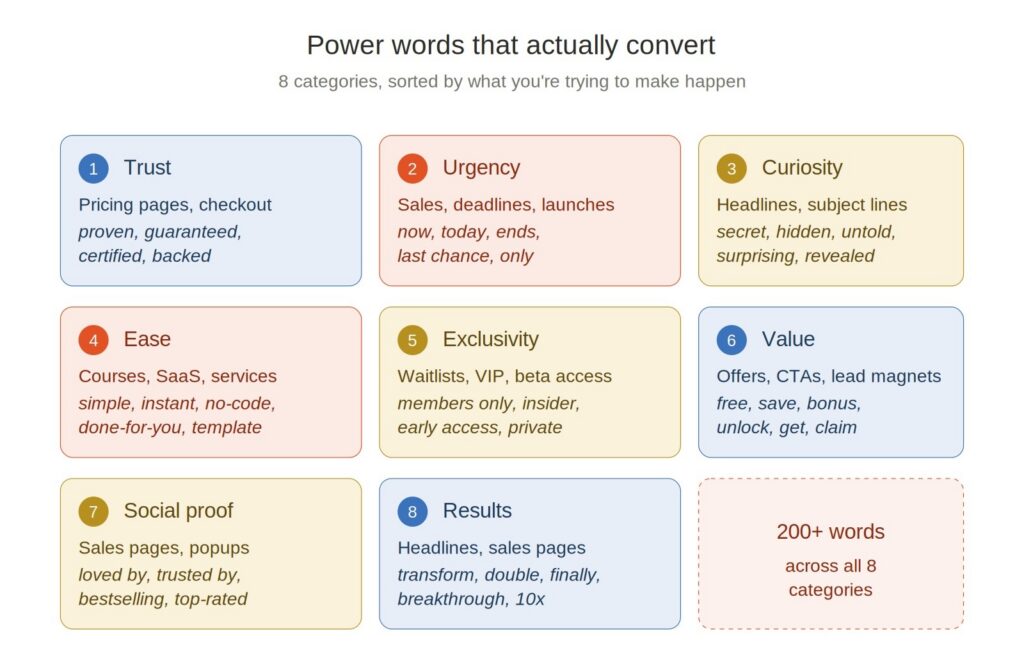
Here’s the working set. Eight emotional buckets, each one tied to a real buyer motivation. Skim, grab what fits your offer, ignore the rest.
1. Trust
For when the reader doesn’t know you yet and is one wrong word away from bouncing. Lean on these in pricing pages, checkout flows, and anywhere you’re asking for a credit card or an email address.
Proven, guaranteed, certified, backed, no-risk, money-back, secure, refundable, verified, tested, official, established, trusted by, recommended, endorsed, authentic, real, transparent, unbiased, independent, trusted, ironclad, peer-reviewed, vetted, accredited
2. Urgency
For nudging fence-sitters off the fence. Works best when the urgency is real (a deadline, a cap, a price change). Works terribly when it’s fake and the reader can smell it.
Now, today, ends, last chance, only, expires, deadline, before, hurry, final, closing, almost gone, limited, while supplies last, until, tonight, this week, instantly, immediately, on the clock
If you’re using urgency on a popup, a countdown timer does a lot of the heavy lifting for you. The clock is the power word.
3. Curiosity
For headlines, subject lines, and lead magnets. The brain hates an open loop. These words crack the loop open and dare the reader to close it.
Secret, hidden, untold, unknown, behind-the-scenes, surprising, weird, strange, unexpected, banned, censored, what nobody tells you, the truth about, revealed, exposed, confession, mistake, discover, peek, sneak, insider, little-known, overlooked, why nobody, the one
4. Ease
For anyone selling a course, a service, or software. Your buyer is already tired. Tell them this won’t add to the pile.
Simple, easy, instant, in minutes, no-code, done-for-you, plug-and-play, painless, effortless, step-by-step, beginner-friendly, fast, quick, lazy, shortcut, template, swipe, copy-paste, ready-to-use, pre-built, one-click, automatic, hassle-free, drag-and-drop, set-and-forget
5. Exclusivity
For lead magnets, waitlists, founders’ pricing, beta access. Nothing makes a thing more attractive than a velvet rope.
Members only, invite, invite-only, insider, early access, private, VIP, exclusive, behind-the-scenes, first dibs, founders, beta, pre-launch, by invitation, reserved, select, elite, limited to, hand-picked, curated
6. Value (a.k.a. Greed)
The classic conversion words. Some of them are clichés because they work. Others are clichés because they used to work. The list below is the ones still pulling weight.
Free, save, bonus, double, unlock, get, claim, included, plus, extra, complimentary, no charge, on us, gift, freebie, deal, rebate, discount, half-off, BOGO, value, worth, ROI, payback, profit
A note on free: it still works, but in 2026 it works best when paired with a specific value claim (“Free template that’s saved my readers 14 hours”) rather than standing alone.
7. Social Proof
For sales pages, popups, and anywhere a hesitant buyer needs to see the crowd before joining it. Pair these with actual numbers when you can.
Loved by, trusted by, joined by, used by, top-rated, bestselling, fan-favorite, customer-favorite, voted, awarded, featured in, as seen on, recommended by, the choice of, 5-star, raving, viral, popular, trending, in demand
If you want to see the full social proof playbook, the social proof guide breaks down which types convert best and where to put them. BDOW!’s social proof popup handles the live notification side of this if that’s what you’re after.
8. Results
For headlines, sales pages, and webinar promos. The reader doesn’t want your thing. They want the outcome your thing makes possible. These words do the bridge work.
Transform, double, 10x, finally, breakthrough, results, outcomes, win, grow, scale, build, launch, ship, achieve, get to, become, master, beat, end, fix, solve, breakthrough, leveled-up, unstuck, momentum
Where to use them (the part most posts skip)
Having a list is the easy part. Knowing where to drop a power word so it actually earns its keep is the rest of the job.
CTA buttons
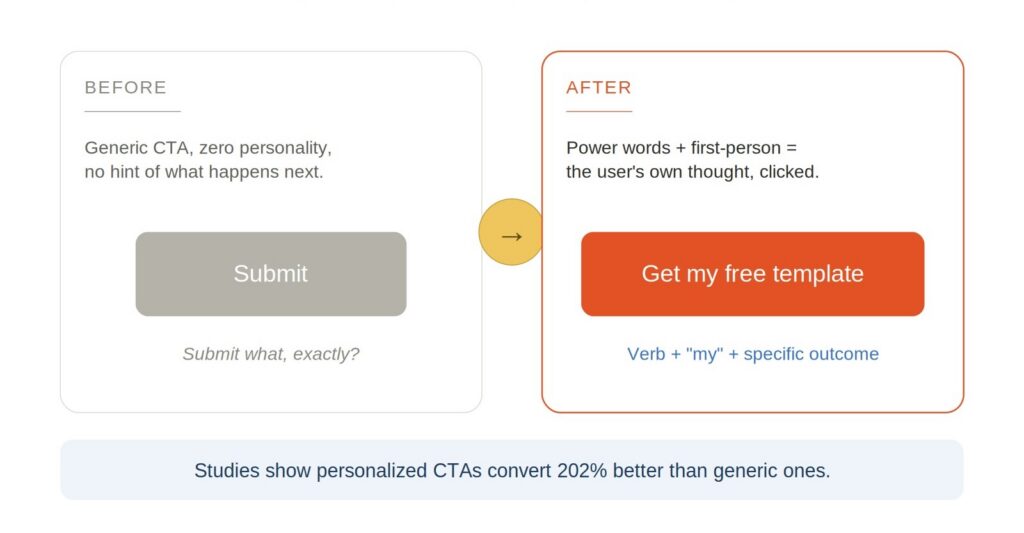
This is the highest-leverage spot in the entire funnel. Studies show personalized CTAs convert 202% better than generic ones, and urgent phrasing can lift CTR up to 90%. Three rules:
- Keep it 2 to 5 words. Analysis of 90 high-converting CTAs found the average length was 3.4 words. Anything longer dilutes the action.
- Start with a verb. Get, claim, start, download, join, unlock, grab. Submit and Click Here are not verbs. They are confessions.
- Use “my” instead of “your.” “Start my free trial” beats “Start your free trial.” It’s a small shift that reads like the user’s own thought.
A power-word-loaded CTA looks like: Get my free template. Claim my spot. Unlock the full course. Start my free 14-day trial.
A power-word-empty CTA looks like: Submit. Click here. Continue. (Reader: …continue what?)
Popup headlines
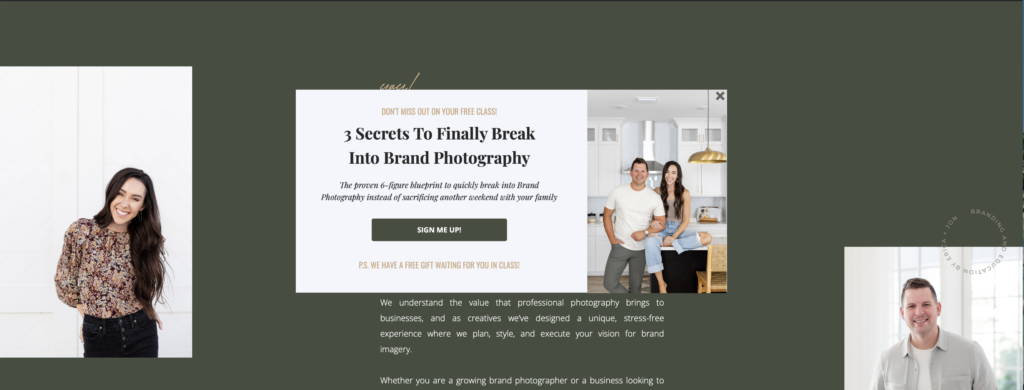
Popups have about three seconds to make a case before someone hits the X. Power words are how you buy yourself a fourth second.
The formula that consistently works: specific outcome + power word + low-friction ask. Example: Steal the exact email template that’s earned my readers $42K. Send it to me.
Compare that to the generic version most popups still run: Sign up for our newsletter for tips and updates.
If you want to see what high-converting popup copy looks like in the wild, the exit intent psychology breakdown has examples worth stealing.
Email subject lines
Subject lines are pure power-word territory. You have one shot at the inbox preview, and the only thing standing between your email and the trash is whether the reader feels something in 6 to 10 words.
The categories that work hardest in subject lines: curiosity (The one mistake everyone makes with…), urgency (Closes tonight), and ease (5 minutes to a better…).
What to avoid: stacking three power words into one subject line. URGENT: Free Exclusive Insider Secret Inside reads like spam because it is functioning like spam.
Lead magnet titles
A lead magnet’s title does most of the conversion work. The asset itself just has to deliver on the promise the title made.
The two categories that overperform here are completeness (ultimate, complete, everything you need) and ease (template, swipe file, cheat sheet, checklist).
So: The Ultimate Email Template Swipe File will outpull Email Marketing Tips for Beginners every day of the week. The first one promises a finished asset. The second one promises homework. If you’re building one from scratch, the lead magnet guide walks through the rest.
Landing page headlines
The headline is doing 80% of the page’s work. Power words here are non-negotiable.
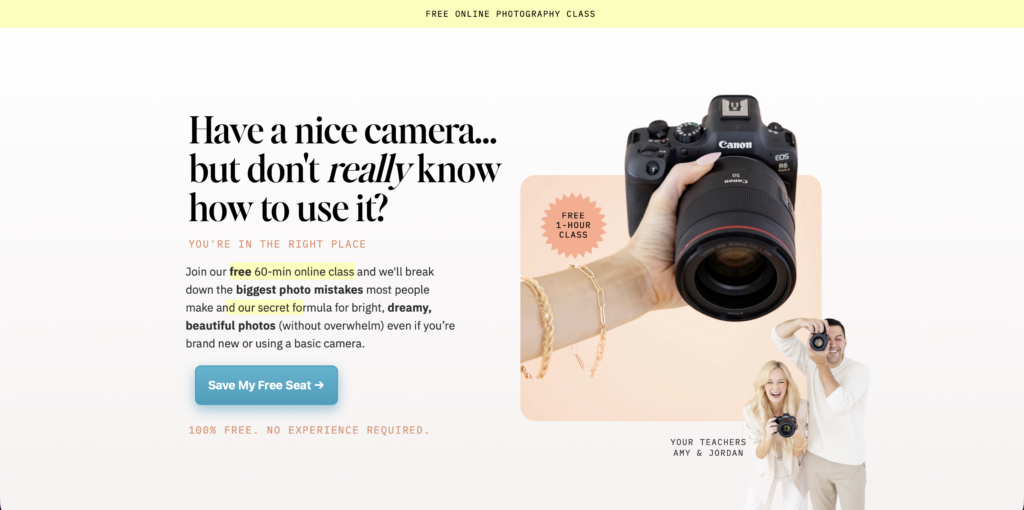
The pattern most high-converting landing pages follow: Outcome + power word + specifier. Example: Finally launch the email list you’ve been putting off (in a weekend, with zero tech overwhelm).
Sales page subheads
Most readers scan. Subheads are where they decide whether to actually start reading.
Drop a power word into every subhead and read the page top-to-bottom looking only at the bolded lines. If the subheads alone tell a coherent story that makes you want to keep going, you’ve nailed it. If they read like a table of contents, you’ve got more work to do.
3 mistakes that kill power words
The list above is the easy part. The harder part is not torching your credibility while using it.
1. Stacking too many in one place. The Ultimate, Proven, Free, Exclusive, Limited-Time Guide to Email is not a headline. It’s a panic attack. One power word per headline, two if they’re working together. More than that and the reader’s BS detector starts blinking.
2. Mismatching the word to the audience. Luxurious and exclusive are wasted on a buyer who’s price-sensitive. Affordable and budget-friendly are wasted on a buyer who came to spend money. Match the word to who’s actually reading.
3. Promising what you can’t deliver. Instant, guaranteed, finally all work because they’re specific. The second your asset doesn’t match the promise the headline made, you’ve trained that reader to never trust your subject lines again. The fastest way to ruin a good email list is to over-promise and under-deliver in subject lines for a month straight.
Quick start: the 3-step swap
If you’ve read this far and you’re thinking cool, but where do I start, here’s the smallest possible action that will move a number this week:
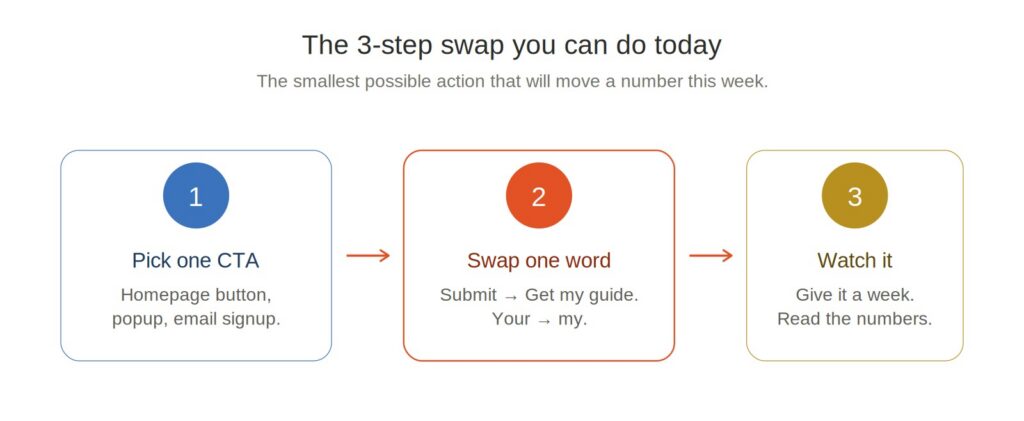
- Pick one CTA on your site. Homepage button, popup, email signup, anything.
- Swap one word. Change Submit to Get my guide. Change Sign up to Save my spot. Change your to my.
- Watch it for a week. If it’s a high-traffic spot, you’ll see the difference fast. If it’s not, you’ll still know more than you did before you ran the test.
That’s the whole game. Power words don’t work because they’re magic. They work because most copy is bland, written by someone who was tired and reached for the obvious word. You’re now the person who reached for the better one.
If you want help running this kind of swap on the popup and CTA side without hiring a developer, BDOW! has a free plan for popups, social proof notifications, and CTA tools. The conversion tools roundup covers the rest of the stack if you want a wider view.
FAQ
Do power words still work in 2026?
Yes, but the bar is higher. Audiences have seen FREE!!! a million times. Power words work best when they’re paired with a specific, credible claim. Free on its own is wallpaper. Free template that took me 8 hours to build is a click.
How many power words should I use per page?
On a CTA: one. On a headline: one or two. On a sales page: as many as you want, as long as no single sentence is doing the work of three.
Are power words manipulative?
They’re persuasive, which is what marketing is. The line is whether the asset behind the word delivers what the word implied. Guaranteed is fine if you actually offer a guarantee. Guaranteed on a no-refund product is a complaint waiting to happen.
What’s the difference between power words and trigger words?
Power words trigger emotional response and nudge action. Trigger words are a related (and overlapping) category focused more specifically on prompting psychological reflexes (urgency, scarcity, fear of missing out). The trigger words breakdown goes deeper if you want the full distinction.
What are the best power words for SEO titles?
The ones that match search intent and survive scanning in a SERP: guide, complete, new, best, free, proven, checklist, template. Pair them with the year if recency matters to your topic. The SEO blog tips post has the full optimization breakdown.



Add A Comment
VIEW THE COMMENTS