People have been predicting the death of email for about as long as email has existed.
Meanwhile, roughly 4.6 billion people use it, and somewhere around 376 billion emails get sent every single day. (Statista, if you want to check my math.) That is not a channel on its deathbed. That is the one marketing channel you actually own… no algorithm deciding who sees you, no rented audience that disappears when a platform changes its mind.
So the real question was never “is email worth it.” It is “what do I actually write?”
That is what this post fixes. Below you get 21 business email examples and templates you can copy, tweak, and send today, organized by what you are trying to do. Then, because templates only get you so far, you get the format that makes any business email work and the tips that get them opened.
Steal the templates. Learn the why. Send better emails.
Table of Contents
What Makes a Business Email Actually Work
Before the templates, the skeleton. Almost every business email that does its job has the same five parts. Get these right and you can write your own from scratch in about ten minutes.
1. The subject line. Its only job is to earn the open. Not to summarize the email, not to be clever for clever’s sake. Pique enough curiosity that clicking feels easier than ignoring it. (More on this below… it matters enough that we gave it its own section.)
2. The opener. First line, real name, and a reason you are in their inbox. Skip the throat-clearing. People decide whether to keep reading in about three seconds.
3. The body. One email, one job. Make the value obvious and make it skimmable. If you are explaining three things, you are really writing three emails.
4. The call to action. Tell them exactly what to do next, once. One clear button or link beats five competing asks every time.
5. The signature. Your name, who you are, and how to reach you. This is where trust quietly lives.
That is the whole machine. Now let’s put it to work.
Templates to Grow Your List
These are the emails that turn strangers into subscribers and subscribers into people who actually open your stuff.
1. Lead Magnet Promotion Email
Send this to your existing list when you launch a new lead magnet. Yes, they already subscribed. No, that does not mean they will notice the new freebie on their own.
Subject line: (New [lead magnet type]) [Lead magnet name]
Body:
Hi [Name],
Quick one. We just made a new [lead magnet type] called [lead magnet name].
Inside, you’ll learn how to [describe what it covers in two or three sentences].
[Click here to grab the [lead magnet name] →]
Know someone else who’d find this useful? Forward it their way.
And if anything breaks or won’t load, just reply to this email. We’ll fix you up fast.
Thanks, [Your signature]
Here is a lead magnet promotion email HubSpot sent that nails the structure.
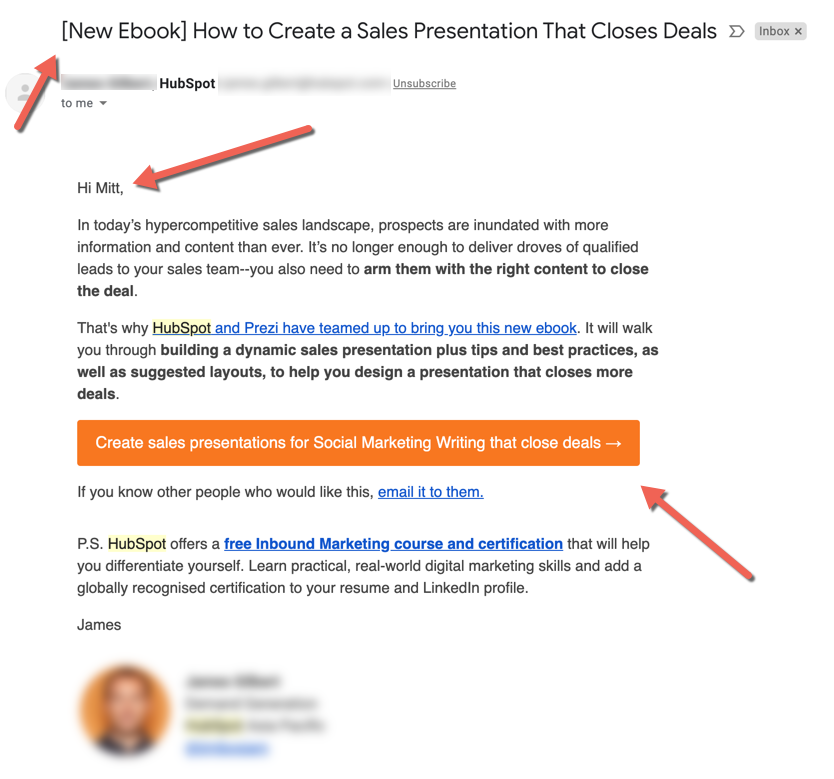
Notice the moves. The subject line leads with a bracketed “[New Ebook]” to grab attention, the opener uses your first name, then it names the problem before it names the solution, then it hands you one button. Subject line, opener, body, CTA. The skeleton, doing its job.
Quick tip on those brackets: Copy Hackers found that adding a bracketed tag to a subject line lifted open rates in their split test. Worth testing on your own list before you assume it works for your audience, but it is a cheap experiment.
2. Lead Magnet Delivery Email
The email that goes out the second someone signs up. Do not overthink this one… they raised their hand, just hand them the thing.
Subject line: here’s your free [lead magnet type]
Body:
Hi [Name],
So glad you grabbed the [lead magnet name].
Inside you’ll learn [describe what they’ll get out of it].
[Click here for instant access to [lead magnet name] →]
Can’t access it? Reply to this email and I’ll sort it out fast.
And if you ever want hands-on help with [the service you offer related to the lead magnet], here’s where to find it: [link to your services page]. I’ve done this for a bunch of people… here’s one example: [link to a case study].
Thanks, [Your signature]
3. Lead Magnet Follow-Up Email
Send this when someone signed up but never opened the delivery email or clicked the link. (You’ll need an email tool that tracks opens and clicks for this one.)
Subject line: here is your free [lead magnet type]
Body:
Hi [Name],
Noticed the [lead magnet type] I sent didn’t get opened, so here it is again.
[Click here to check out the [lead magnet name] →]
Thanks, [Your signature]
Frank Kern runs a sharper version of this. He doesn’t just track whether you opened the email… he tracks whether you finished the video the email pointed to. Didn’t watch the whole thing? You get a nudge to come back and finish. That is follow-up based on behavior, not guesswork, and it is the kind of thing that quietly doubles the return on a single piece of content.
9. Newsletter Email
Send this every one to four weeks to stay in the inbox without selling anything. The goal is to be useful often enough that they remember who you are when you do have something to sell.
Subject line: here are a few things worth your time
Body:
Hi [Name],
A quick roundup of what’s worth reading this week, from our blog and a few other corners of the internet:
[Title of 1st article, linked] [One-line description]
[Title of 2nd article, linked] [One-line description]
[Title of 3rd article, linked] [One-line description]
Thanks, [Your signature]
10. Latest Blog Post Email
Send this when you publish something new. Your subscribers signed up to hear from you… a new post is exactly the reason they did.
Subject line: (new post) [Post title]
Body:
Hi [Name],
Just published something I think you’ll like.
In it, you’ll learn [describe in two or three lines].
[Click here to read it →]
If your people would find it useful too, here’s an easy share link: [insert share link].
Thanks, [Your signature]
Templates to Make the Sale
These are the emails that move people from “interested” to “paid.” Persuasion lives here, and that is fine… just be honest about the fact that you are selling. People can smell a fake.
4. Product Launch Email
Send this when you open the doors on something new.
Subject line: it’s here: the [product name]
Body:
Hi [Name],
Today’s the day. We just opened up [product name].
It helps you [describe the problem it solves and how].
[Click here to see what it does →]
One thing: grab it before [time frame or number of spots], because [reason the deadline is real].
Don’t take my word for it. Here’s what a recent customer said: [add a short review].
Questions? Reply here or use the live chat on the product page. Someone’s around to help.
Thanks, [Your signature]
Want more of these? We broke down the 10 best product launch email examples separately.
6. Discount Offer Email
Send this when you’ve got a deal. The trick is making the discount feel like a thank-you, not a fire sale.
Subject line: a little something for you, inside
Body:
Hi [Name],
Thanks for being a [your company name] customer. People like you are the reason we’re still here, so here’s a discount that’s just for you.
Use code [unique code] for [discount amount or percentage] off anything in the store: [link].
Move quick though… this one’s only good for the first [number or time limit].
Thanks, [Your signature]
5. Testimonial / Review Request Email
Send this a few days after someone buys, once they’ve actually used the thing. Ask too early and you get a shrug. Ask after they’ve had the win and you get a review worth posting.
Subject line: could you do us a small favor?
Body:
Hi [Name],
Hope you’re getting good use out of your [product name].
If it’s working for you, would you mind helping the next person who’s deciding whether to buy? A quick review on [insert link] takes under three minutes and means a lot.
Really appreciate it.
Thanks, [Your signature]
One rule: only ask for reviews on your own site and on third-party sites that allow it. Some platforms (Yelp, for one) explicitly don’t want you soliciting reviews, so check before you send.
Amazon times this perfectly… the review request lands a few days after delivery, right when you’ve formed an opinion.
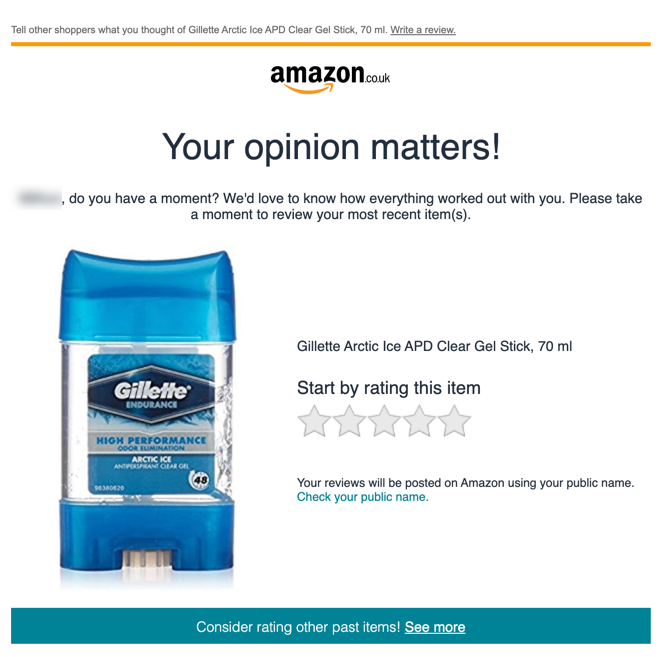
If you run an ecommerce store, set this to fire automatically a few days after delivery. You’ll collect way more reviews than you would chasing them by hand.
15. Products / Services Pitch Email
Send this to a potential client you’d actually like to work with. The version that works leads with them, not you.
Subject line: i like what you’re doing
Body:
Hi [Name],
Big fan of what you’re building. You’re clearly doing well at [a specific, real compliment].
One thing I noticed though: [the problem you spotted].
That’s actually what we fix. [Your company] helps businesses [your solution]. After working with us, you’d [describe the change].
Here’s a recent example: [link to a case study and the result].
If this is interesting, just reply and we’ll set up a quick call.
Thanks, [Your signature]
7. Re-Engagement Email
Send this to subscribers who’ve gone quiet, right before you’d otherwise remove them. Counterintuitively, telling people you’re about to delete them is what gets them to click.
Subject line: are you still there?
Body:
Hi [Name],
I’m cleaning up my list, and you haven’t opened anything from me in [number] months.
Totally fine if you’re done. No hard feelings.
But if you still want to hear from me, just click below and you’ll stay on.
[Yep, keep me on the list →]
No need to sign up again. One click does it.
Thanks, [Your signature]
8. Segmentation Email
Send this when you want to understand your subscribers well enough to stop sending them stuff they don’t care about.
Subject line: want to make sure i’m sending you the right stuff
Body:
Hi [Name],
Hope the tips have been useful.
I want to keep sending you good stuff, but only the stuff you actually want. Mind telling me what you’re into? Just click whichever fits:
[Topic 1, linked] [Topic 2, linked] [Topic 3, linked]
Don’t see your thing? Reply and tell me what you’d rather read.
Thanks, [Your signature]
Business coach Jenn Scalia ran a smart version of this… she asked subscribers how much they currently earn, then used the answer to send each segment more relevant content. Higher opens, lower unsubscribes, more sales. MailChimp’s data backs this up: segmented campaigns reliably outperform the batch-and-blast approach across opens and clicks. The more you know, the less you waste.
Templates for Outreach and Partnerships
These go to people who don’t know you yet. The bar is higher, the personalization is non-negotiable, and the ask should be small.
11. Blog Post Promotion Email
Use this to reach out to bloggers and creators about something you’ve published.
Subject line: could you help me out?
Body:
Hi [Name],
Just read your post on [post title]. Really good… I especially liked how you [specific detail].
I’m reaching out because I wrote something related: [your post title + link]. Figured it might be relevant to your piece on [their post]. Would you take a quick look and tell me what you think?
Thanks, [Your signature]
Two things make or break this one. First, only praise a recent post with real, positive engagement… and make sure the person you’re emailing actually wrote it (not a guest contributor). Second, notice there’s no ask for a share or backlink. That’s on purpose. Those asks rarely land cold. Ask for the favor later, after they’ve replied and told you what they think.
12. Guest Post Outreach Email
Use this to pitch a blog you’d like to write for. Read their guidelines first and rewrite accordingly… some want topic pitches, some want a full draft.
Subject line: i’d love to write for your blog
Body:
Hi [Name],
Big fan of your blog. Your post on [post title] was especially good.
I’d love to contribute an original piece. I’ve read your guidelines and I’ll follow them. [Confirm a specific guideline, e.g., “Happy to make this a 1,500+ word piece with stats and examples.”]
A few samples of my work: [Links to relevant published posts]
Want me to send topic ideas, an outline, or a full draft? Whatever’s easiest for you.
Thanks, [Your signature]
13. Affiliate Partnership Email
Use this to reach out to people who could promote your product to an audience that trusts them.
Subject line: your readers will love this
Body:
Hi [Name],
Big fan of your site. Loved your review of [product name].
We just launched something similar, [product name], and I think your readers would be into it. Want to review it? We’ll send you a free sample.
Here’s our affiliate program: [link]. You earn [number or percentage] on every sale.
Hope we can team up. Any questions, just ask.
Thanks, [Your signature]
A strong version of this includes proof… think user counts or a solid third-party rating. It makes the product look like less of a gamble for the person putting their name behind it.
14. Podcast Invite Email
Send this to someone you’d like to interview.
Subject line: i just listened to your episode on [podcast]
Body:
Hi [Name],
Found your work through [podcast name] recently. So many good takes in that episode.
I host a podcast too, [name + link], and I’d love to have you on. We’ve got [number of subscribers/downloads], and past guests include [names].
Interested? I’ll work around your schedule.
Thanks, [Your signature]
16. Influencer Outreach Email
Send this to a social creator you’d like to partner with.
Subject line: we’d love to work with you
Body:
Hi [Name],
I’ve followed you on [platform] for a while. You share a lot of [content type] and you’ve built a following that clearly trusts you.
I think I’ve got your next product to feature: [product name + link]. It helps [what it does], and your audience could use it to [specific use].
If you’re open to it, we’ll send a sample, help you create the content, and pay you for your time.
Thanks, [Your signature]
Templates for the Client Lifecycle
These keep things smooth once someone’s actually working with you. Less persuasion, more clarity. The goal is to sound organized and make the next step obvious.
17. Call Invite Email
Send this to someone who signed up for a free consultation.
Subject line: about your free call with [your name]
Body:
Hi [Name],
Thanks for booking a free call. Looking forward to it.
Grab a time that works for you here: [scheduling link].
Any questions before we talk? Just reply.
Thanks, [Your signature]
18. Call Follow-Up Email
Send this right after the call, while it’s fresh.
Subject line: following up on our call
Body:
Hi [Name],
Thanks for the call. Really enjoyed learning about you and your business.
Quick recap of what we covered: [A few bullet points]
I’ve attached a custom plan for you. Take a look and let me know if you’d like to move forward.
Thanks, [Your signature]
19. Client Onboarding Email
Send this the moment someone hires you. First impressions of being organized go a long way.
Subject line: getting [project name] started
Body:
Hi [Name],
So glad to be working with you. Excited to get going.
I’m setting up the project now. We run things in [your project tool]… I’ll create a board so you can follow progress.
I’ve attached a doc listing what I’ll need from you to start. Add your details there, or share anything sensitive through a password manager rather than plain email.
Questions anytime: [email] or [phone].
Thanks, [Your signature]
20. Feedback Request Email
Send this once the work is done. Make it clear you actually want the honest version.
Subject line: help us get better
Body:
Hi [Name],
Hope the work’s been serving you well.
We’re always trying to improve. Would you take five minutes to fill out this quick form? [link]
Be honest… if something fell short, we want to hear it. We read every response and we act on it.
Thanks, [Your signature]
21. Event Invite Email
Use this to invite clients to a company event.
Subject line: you’re invited to [event name]
Body:
Hi [Name],
It’s that time again: [event name].
It’s a day where we [describe the event in a line or two].
You’ve become a real part of what we do, and we’d love to have you there. No pressure if you can’t make it.
RSVP here: [link].
Thanks, [Your signature]
How to Write Business Emails That Get Opened (and Answered)
Templates get you 80% of the way. The last 20%, the part that actually moves your numbers, comes from writing like a human who respects the reader’s time. Here’s how.
Write a Subject Line That Earns the Click
Your subject line has exactly one job: get the open. That’s it. Don’t try to cram the whole email in there.
Reveal just enough to spark curiosity and let the body do the rest. America’s Test Kitchen does this with a three-word line like “Building Better Bowls.”
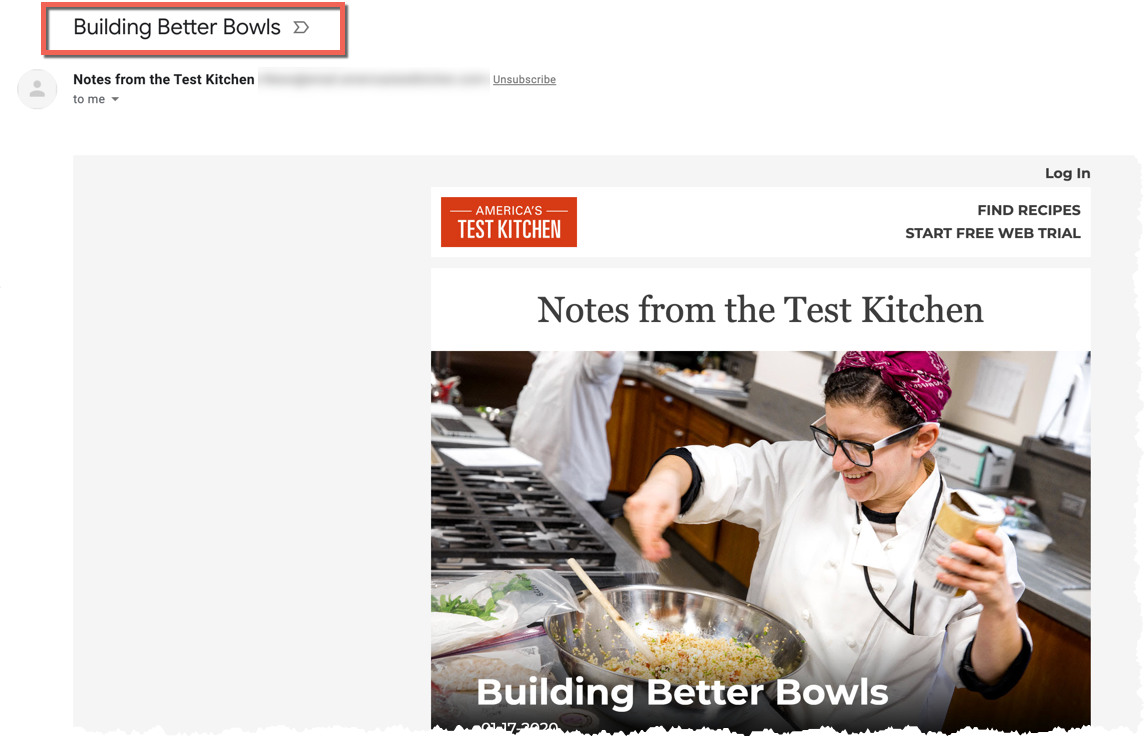
Vague? On purpose. You can’t tell if it’s about a gadget, a recipe, or a Buddha bowl, so you click to find out. Short subject lines tend to win, so keep yours tight. If you want a head start, our guides to headline formulas, power words, and trigger words all translate straight to subject lines.
Keep It Casual and Friendly
One easy trick: don’t capitalize every word in your subject line. Title Case reads like a press release. Lowercase reads like a note from a friend, and people open emails from friends.
When a subject line is clearly Trying Very Hard To Get Your Attention, your guard goes up and you assume you’re about to be sold to. You don’t want that reaction. You want it to feel like one person wrote it for one person. (Bonus: capitalizing everything can also trip spam filters.) Brackets and the occasional emoji can lift opens too… just don’t turn your subject line into a ransom note.
Personalize It (Past the First Name)
Personalized subject lines can meaningfully lift open rates, and personalized promotional emails drive far higher transaction rates than generic ones. But “Hi [First Name]” is not personalization. That’s a mail merge.
Real personalization means relevance. If you’re emailing a list, build a persona and write to that person’s actual situation. If you’re emailing one human, spend five minutes on their site, their LinkedIn, their recent posts, then write something only they would get. That’s the email that gets a reply.
Get to the Point
The average professional gets well over a hundred emails a day. Nobody’s settling in with a coffee to read yours. They want the point, fast.
So give it to them. This matters most for cold outreach… the best cold emails make their ask in under 50 words. (Warm audiences on your newsletter will give you more rope. They know you. Use it wisely.)
Proofread, Then Simplify
Run every email through a spell-check, then read it out loud. Then cut it down. Aim for something a busy person can skim at a fourth-to-sixth-grade reading level… not because your audience isn’t smart, but because they’re busy. Simple reads faster, and faster gets read.
Now Go Write Some Emails
You’ve got two moves from here.
Move one: swipe the templates above, drop in your details, hit send. Fast, and a perfectly good place to start.
Move two: use the format and the tips to write your own from scratch. Slower, but it’ll sound like you, and that’s what actually builds a list that opens your email.
Either way, here’s the thing none of these templates can do for you: fill your list in the first place. The best re-engagement email in the world is useless if there’s nobody to re-engage. That part happens on your website, with forms and popups that turn visitors into subscribers before they click away.
Get the list growing. Then come back here and pick a template.



Add A Comment
VIEW THE COMMENTS