Picture the last time you bought something faster than you meant to.
Maybe a hotel room when the booking site said only 2 left at this price. Maybe a flight when a yellow banner said 3 other people are looking at this fare right now. Maybe a pair of shoes when the size you wanted had a little red “Low Stock” tag underneath it.
You felt the pressure. You acted on it. And here’s the embarrassing part: somewhere in the back of your head, you knew exactly what was happening. The site was using a basic psychological lever to speed up your decision, and the lever still worked anyway. (It works on the marketers who write blog posts about it, too. Hi.)
That lever is scarcity marketing. And the reason it’s worth taking seriously is that almost every conversion-optimized site on the internet uses some version of it. The reason it’s also worth being careful about is that the line between “effective urgency” and “trust-destroying manipulation” is thinner than most marketers admit.
Table of Contents
What is scarcity marketing?
Scarcity marketing is a strategy that uses limited supply, limited time, or limited access to increase the perceived value of a product or offer and motivate faster buying decisions. It works because people assign more value to things that are harder to get, and because the fear of missing out tends to override the impulse to “think it over.”
There are three flavors of scarcity you’ll see in the wild:
- Time scarcity: the offer expires soon (sales, countdowns, seasonal drops)
- Quantity scarcity: the product is almost gone (low stock, limited editions)
- Access scarcity: only certain people can get it (waitlists, VIP tiers, invite-only launches)
The underlying mechanic is the same across all three: humans value what they might lose more than they value what they might gain. That’s not a marketing trick. That’s just how the brain is wired.
Why scarcity marketing works (the 90-second science version)
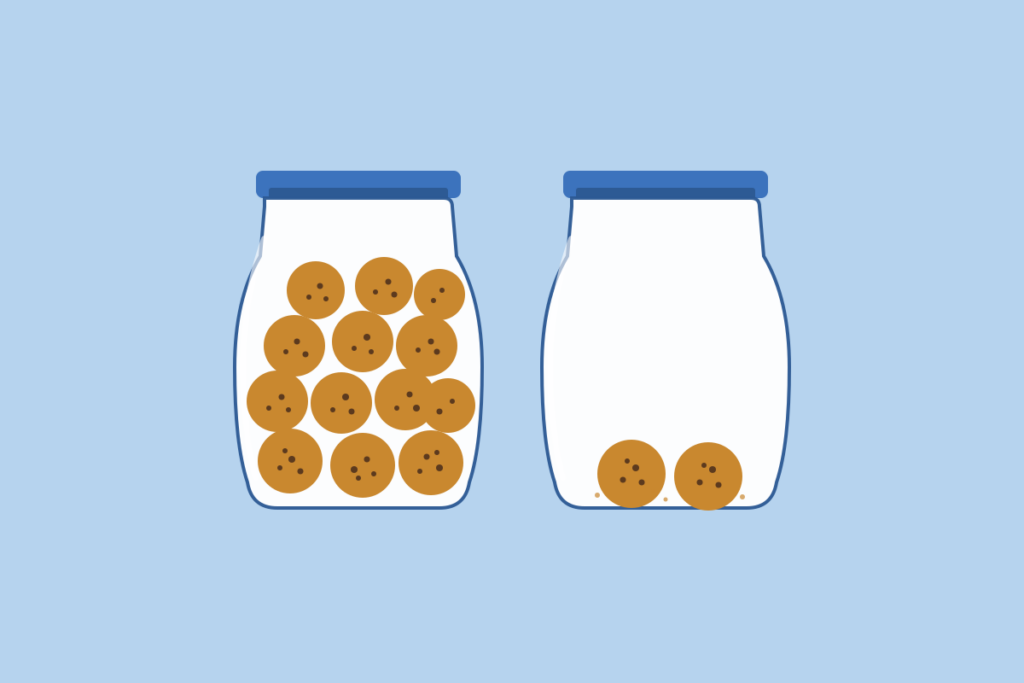
In 1975, three researchers named Worchel, Lee, and Adewole asked people to rate cookies. Same cookies. Two jars. One jar had 10. The other had 2.
People rated the cookies in the jar of 2 as significantly better.
Same cookies.
Then the researchers ran a second version: they started both jars with 10, and removed 8 cookies from one jar while the participants watched. People rated those cookies even higher than the cookies that were scarce the whole time. Watching the supply disappear in real time made the cookies feel more valuable.
The cookies did not taste different. The cookies were identical. Our brains just got squirrelly about supply.
This is what psychologists call commodity theory, and it explains a few things at once:
- Scarce stuff feels exclusive (you have access, others don’t)
- Scarce stuff feels more valuable (basic supply and demand, projected onto perception)
- Scarce stuff makes people feel a little powerful (you got the thing)
Stack that on top of loss aversion, which is the finding that losing something feels about twice as painful as gaining something feels pleasurable, and you have the engine of every “act now” message ever written. People aren’t trying to get the deal. They’re trying not to lose the deal.
That’s also why FOMO is such a reliable lever. (We wrote a whole post on the different types of social proof if you want to nerd out further on this.)
One thing before we get into tactics. Scarcity is a multiplier, not a magic spell. If nobody wants what you’re selling, putting a countdown on it doesn’t help. It just makes the indifference more visible. The tactics below all assume there’s already something someone wants. Build the want first. Add the urgency second.
9 scarcity marketing tactics that actually work
These split into three buckets: time scarcity, quantity scarcity, and demand signals. You don’t need to use all nine. Pick the ones that fit what you sell.

Purchase countdowns
A timer next to a product is the most direct form of scarcity. It puts a literal clock on the decision, and that clock activates loss aversion. Every second that ticks down is a second of “I’m about to lose this.”
eBay built half its empire on this. When you bid on something with 38 seconds left on the clock, you are not weighing utility. You are gripped by the very specific dread of watching someone else click “Place Bid” before you do. Price goes up. Clock goes down. Prefrontal cortex goes on vacation.
You don’t need an auction model to use this. Any time-limited offer can carry a countdown. A 24-hour flash sale. A 72-hour launch discount. A “this cart expires in 15 minutes” message during checkout.
The honest answer on how long the countdown should be: short enough to create urgency, long enough that the visitor has time to actually buy. A 5-minute timer on a $400 product feels coercive. A 5-day timer on a $19 ebook feels lazy. Match the timer to the decision size.
(This is, by no coincidence, what BDOW!’s countdown timer is built for. We’ll come back to that.)
Sale price countdowns
Slightly different mechanic: the product isn’t going anywhere, but the price is. The clock counts down to when the discount disappears.
This is what conference organizers do when they sell virtual tickets at one price for early-bird, another for general admission, and the highest price at the door. Each tier has a deadline. Each deadline has a countdown. By the time someone’s been on the page for 90 seconds and watched the clock tick from 4:23:11 to 4:21:48, the math has been done in their head. Buy now or pay more later.
You can layer this. A limited-time price PLUS a limited quantity at that price is two scarcity mechanics stacked, and they compound. “20% off the first 50 orders, until Friday” is doing a lot more work than either of those alone.
The copy on these matters as much as the timer. (We have a whole list of trigger words that earn their keep in this exact moment.)
Shipping cutoff countdowns
This one is wildly underused by small businesses, and it’s basically free conversion lift.
Amazon perfected it: “Order in the next 2 hours 14 minutes for delivery tomorrow.” You weren’t planning to buy that thing today. You were planning to buy it… eventually. But now you’re staring at a clock that says you can have it tomorrow if you decide in the next 134 minutes. Suddenly “eventually” feels like a stupid plan.
Here’s the thing. You don’t need Amazon’s logistics empire to do this. If you ship orders from your apartment three times a week, you can still say “order by 6pm Wednesday for delivery this weekend.” The cutoff is real. The urgency is real. The lift is real.
For service businesses, the same logic works on booking windows. “Spots in next month’s calendar close Friday.” “Onboarding starts the first Monday of every month.” Whatever your scheduling reality is, name it, and let the deadline do the work.
Seasonal offers
Pumpkin spice is the case study, and we don’t need to belabor it. The reason Starbucks sells the same drink 47 different ways in October is that scarcity, even fake-feeling calendar scarcity, drives behavior.
Here’s the interesting part. A purchase tracking study by NPD Group found that seasonal beverages weren’t just selling well; they were producing larger basket sizes. The average check on a pumpkin spice latte order was $7.81, compared to $6.67 for a non-seasonal order. People in seasonal-purchase mode also reached for a pastry. They were in “treat yourself” mode. The seasonal context unlocked spend they wouldn’t normally green-light.
So how do you do this if you don’t sell beverages?
- Digital products: seasonal bonuses bundled with the main product. Black Friday templates. Spring planning packs. Whatever fits your audience’s calendar.
- Ecommerce: rotate inventory visibly. Pull seasonal SKUs after a window, and let customers see you doing it. “Last day for the Halloween collection” is a deadline.
- Service businesses: offer a loyalty rate or a holiday-themed package during a specific window. A photographer running “winter family minis” is doing seasonal scarcity perfectly.
The trick is that the season has to actually end. If you run the same “spring sale” in November, you’re not doing seasonal marketing anymore. You’re just doing a sale.
Low stock notices
When a shopper sees that only 2 of the size they want are left, the decision speed changes. They were comparing tabs. Now they’re checking out.
Zappos does this. Hotel sites do this. Sephora does this. The mechanic is simple: show real stock levels on the product page, especially when they’re low. The specificity matters. “Almost gone” is easy to ignore. “Only 3 left in your size” is not.
One rule that should be obvious but isn’t always honored: if you display low stock, it has to be true. The “only 2 left” badge that’s been there for nine months is the kind of thing customers eventually notice, and once they notice, you don’t get their trust back. Trust is the cheapest thing to spend and the most expensive thing to earn back.
If your inventory genuinely doesn’t run low because you’re selling digital products or services, you can still do a version of this with seats, slots, or session counts. “12 of 25 spots filled” works the same way for a course as “only 3 left” works for sneakers.
Limited-edition drops
There’s a version of scarcity that isn’t about running out by accident. It’s about running out on purpose.
Brothers Leather Supply makes small-batch wallets and bags. They mark certain products as limited runs and let visitors see when those are getting low. The red text stands out on the page. It signals: this is not the same shirt you can buy from 40 other sites. Once these are gone, they’re gone.
This is the same energy behind sneaker drops, capsule collections, and “anniversary edition” anything. The product is deliberately limited so that owning it means something. You’re not buying the thing. You’re buying the version of the thing that only a few people get to own.
You don’t have to be a fashion brand to do this. Some ideas:
- Solopreneur version: a limited cohort of a course or coaching program. “20 seats, opens once a year.”
- Service business version: a capped offer. “Taking 5 new clients in Q2, then closing the list.”
- Creator version: a one-time bundle that only exists for a launch window, then disappears.
The trick is the same as with seasonal offers: the limit has to be real. If you say “only 20 seats” and then quietly add 30 more when you don’t sell out, you’ve taught your audience that your scarcity is theater. They won’t act fast next time, because there won’t be a next time worth acting fast for.
(If you’re building a lead magnet for a launch, this is a great place to bake in a limited bonus that disappears when the cart closes.)
Spotlight customer behavior
There’s a quieter cousin of scarcity that uses other people’s interest to signal demand, which signals supply pressure, which signals “you should probably hurry up.”
Airbnb does this with wishlists. When you’re looking at a property and you see “saved by 1,247 travelers,” your brain does some quick math. A lot of people want this. It’s not infinite. It’s probably going to book up. I should probably book.
That’s social proof acting as a scarcity cue. The supply isn’t visibly low, but the demand is visibly high, and the implication is the same: act now or someone else will.
Robert Cialdini said something about this in Influence that’s stuck with marketers for decades. (Paraphrased: people don’t just want scarce things more, they want scarce things most when they have to compete for them.) Visible demand creates the perception of competition. Competition is what supercharges the urge to act.
You don’t need millions of users to do this. “37 people booked this month” works on a small consultancy site exactly the way “saved by 1,247 travelers” works on Airbnb. The mechanism scales down.
(More on this in our deep dive on types of social proof.)
Use specific numbers that signal demand
Big numbers are powerful. Specific numbers are more powerful. Specific odd numbers are the most powerful.
Compare these three:
- “Thousands of authors use this software”
- “Over 8,000 authors use this software”
- “8,247 authors use this software”
The first one is forgettable. The second one is fine. The third one feels real, because it could only have come from someone who actually counted.
We use a version of this on the BDOW! homepage. “Over 30k Sites Can’t Be Wrong” is shorthand for “a lot of people made this same decision before you, and they’re still here.” It’s a demand signal that creates a soft scarcity effect, because the implicit message is you’re behind. Other people figured this out already.
This tactic costs nothing to deploy if you have the numbers. Customer count. Subscriber count. Books sold. Hours of footage processed. Whatever metric makes sense for your business, name it, and use the actual number instead of rounding.
Round numbers feel like marketing. Specific numbers feel like data. (Worth a glance at our post on power words for how to frame these stats in copy that lands.)
Real-time activity notifications
The pop-up that says “Sarah from Boise just booked this room” is doing a very specific job. It’s translating online shopping, which is solitary, into something that feels like a busy storefront, which is not. You can practically hear the line behind you.
Expedia does this aggressively. So does Booking.com, so do most of the hotel aggregators, and a lot of ecommerce sites have adopted versions of it for purchase notifications. The pattern is always the same: real customer, recent action, location detail. The specificity is what makes it work. “Someone just bought this” is forgettable. “Sarah from Boise booked this 4 minutes ago” feels real, because the details are too weird to invent.
This is the closest thing to a physical line outside a store that you’ll ever build online. And it stacks beautifully with the other tactics on this list. Real-time notifications plus a low-stock badge plus a countdown timer is three scarcity signals firing at once, without any of them feeling overdone.
(Want to add these to your own site? BDOW!’s social proof pop-ups handle this in about three clicks.)
When scarcity marketing backfires
Scarcity is a multiplier. Multipliers cut both ways.
Used well, scarcity adds intensity to demand that already exists. Used badly, it tells your audience you don’t respect them. Here are the four ways people most reliably blow this up:
Faking it. The countdown timer that resets when the page reloads. The “low stock” badge that’s been at 3 since the Obama administration. The “today only” sale that runs again every Tuesday. Customers notice. Maybe not the first time. But eventually one of them screenshots it, and once trust is gone, no amount of urgency will get it back. The cost-benefit on faked scarcity is so bad it shouldn’t even be a tempting shortcut.
Putting it on everything. If every product has a timer, every product has low stock, and every email is “LAST CHANCE,” the signal disappears. Scarcity works because it stands out. When everything is urgent, nothing is. Use these tactics on real moments. Save the volume.
Skipping the “want” part. Slapping a countdown on a product nobody wants doesn’t manufacture demand. It just announces that you don’t have demand. Scarcity amplifies wanting. It does not create it. Before you reach for the timer, make sure the offer is actually compelling.
Cranking the pressure into coercion. There’s a line between “this expires in 24 hours” and “BUY NOW OR LOSE YOUR LIFE FOREVER,” and that line is real. When the urgency feels engineered to override the customer’s judgment rather than inform it, you’ll get the sale. You’ll also get the chargeback, the refund request, and the one-star review that says “felt pressured into buying.”
The honest version: real constraints, used sometimes, on things people actually want.
Worth testing too. What works for one audience reads as desperate to another. A/B test your timers, your stock badges, and your social proof popups before assuming what worked for someone else’s brand will work for yours.
How to actually build this on your site
Most of the tactics above need one of three things:
- A countdown timer
- A popup that shows low stock or social proof
- A way to schedule offers by date
You can hand-code all of this. You can also use a tool that handles all three without making you open a JavaScript console. BDOW! is one of those tools, and yes, this is the part of the post where we mention that.
Countdown timers are a click to add to any popup, sticky bar, or embedded form. Set the end date, and BDOW! auto-hides the offer when time’s up, so you don’t have a dead “SALE ENDS TOMORROW” banner on your homepage in February.
The social proof FOMO popup handles the “Sarah from Boise just booked” notifications, plus low-stock messaging, plus purchase notifications. Real activity, displayed in real time, configured once.
Date-based display rules mean you can build a seasonal calendar in advance. Your Black Friday popup goes live at midnight on November 27. Your January reset offer shows up for one week. You don’t have to remember to do anything.
If that sounds useful, BDOW! is free to try for 14 days, no card required.
Quick recap
The nine tactics, one more time:
- Purchase countdowns
- Sale price countdowns
- Shipping cutoff countdowns
- Seasonal offers
- Low stock notices
- Limited-edition drops
- Spotlight customer behavior
- Specific numbers that signal demand
- Real-time activity notifications
The whole thing in one sentence: scarcity works on things people already want. Build the want first. Add the urgency second. Don’t fake any of it.
Now go put a timer on something!



Add A Comment
VIEW THE COMMENTS