What Is a Tagline? 60+ Examples & How to Write One (2026 Guide)
“Just Do It.”
Three words. Billions of dollars in brand value. When you read that phrase, you don’t think about shoes. You think about Nike. That’s what a great tagline does.
A tagline is basically the verbal version of your logo. It’s that short, punchy phrase that tells people what your brand stands for and makes it stick in their heads. Think “I’m Lovin’ It” for McDonald’s or “Think Different” for Apple.
The problem? Most businesses screw this up completely. They’re either too vague (“Empowering Your Success”), too complicated (“Innovative Solutions for Dynamic Paradigms”), or so boring nobody remembers them five seconds later.
You’ve got maybe 3 seconds to tell someone what you do before they bounce from your website. Your tagline needs to do some heavy lifting in those 3 seconds. It’s not just marketing decoration. It’s the shortest possible answer to “What does your brand stand for?”
This guide shows you what makes a tagline actually work. You’ll see 60+ examples from brands doing it right. And you’ll get a simple framework to write your own. Whether you’re launching something new or refreshing your brand, you’ll walk away with a tagline people actually remember.
Here’s what we’re covering:
- What a tagline is (and why it’s different from a slogan)
- 60+ real examples organized by industry
- How to write one using a proven process
- When to update your tagline
- Common mistakes to avoid
Use this to jump to a section:
Table of Contents
What Is a Tagline?
A tagline is a short, memorable phrase that tells people what your brand does or stands for. It’s the verbal equivalent of your logo. A few words that capture your brand’s essence and make you instantly recognizable.
The basic definition: A tagline (also called a brand tagline or marketing slogan) is a short phrase, usually 2-7 words, that goes with your brand name. It reinforces your positioning, sets you apart from competitors, or explains your core benefit.
Think of it as your elevator pitch boiled down to its purest form.
Why Taglines Matter More Than Ever
There’s this psychological thing called the “mere-exposure effect.” Basically, people start to prefer things just because they’re familiar with them. Every time someone sees your tagline, you’re building that familiarity. In 2025, where attention spans are measured in seconds and everyone’s competing globally, a memorable tagline is one of the fastest ways to build brand recognition.
Consider this: the average person sees somewhere between 4,000 and 10,000 ads per day. Your tagline is your shortcut through all that noise.
What Makes a Great Tagline?
The best taglines do one (or more) of these things:
1. Describe what you do clearly
Example: Slack’s “Where Work Happens.” You immediately get that it’s a workplace tool.
2. Promise a specific benefit
Example: BMW’s “The Ultimate Driving Machine.” You know what you’re getting: peak performance.
3. Capture your brand personality
Example: Apple’s “Think Different.” It’s not about computers. It’s about being a rebel.
4. Create an emotional connection
Example: Coca-Cola’s “Open Happiness.” Suddenly soda is about feeling good, not just taste.
The Anatomy of a Memorable Tagline
Great taglines share these traits:
Short: 2-7 words is the sweet spot (though some exceptions work)
Clear: No jargon or confusing metaphors
Memorable: Easy to recall after hearing once
Distinct: Sounds different from competitors
Relevant: Aligns with what your brand actually delivers
Timeless: Still makes sense in 5+ years
Your tagline shows up everywhere: your website header, business cards, email signatures, social media bios, and yes, those strategic popups that capture leads when your messaging actually resonates with visitors.
Now let’s look at what works in the real world.
60+ Tagline Examples by Industry (2025)
Nothing beats seeing what actually works. Here are 60+ taglines from brands across industries, organized so you can find inspiration relevant to your business.
Technology & Software
Apple: “Think Different”
Positioned Apple as the creative’s choice when competitors focused on technical specs. Still relevant 25+ years later.
Microsoft: “Be What’s Next”
Forward-looking and empowering. Focuses on the user’s potential, not the product’s features.
Google: “Do the Right Thing”
Simple ethical statement that set expectations for a tech giant in an industry not exactly known for ethics.
Intel: “Intel Inside”
Made an invisible component into a recognizable mark of quality. Brilliant marketing for a B2B product.
IBM: “Think”
One word. Maximum impact. Conveys intelligence, problem-solving, and partnership all at once.
Salesforce: “The Customer Success Platform”
Crystal clear benefit statement. You know exactly what problem it solves.
Adobe: “Creativity for All”
Democratizes creative tools. Makes professional software feel accessible instead of intimidating.
Samsung: “Do What You Can’t”
Aspirational and action-oriented. Challenges users to push boundaries.
SaaS & B2B Software
Slack: “Where Work Happens”
Positions the product as essential infrastructure, not just another app in your already-crowded stack.
Mailchimp: “Turn Emails Into Revenue”
Direct benefit. No ambiguity about what success looks like.
HubSpot: “Grow Better”
Two words that capture their entire inbound marketing philosophy. Simple but powerful.
Asana: “Work On Big Ideas, Without the Busywork”
Names the problem (busywork) and the solution (focus on what matters) in one breath.
Zoom: “One Platform to Connect”
Clear and functional. You know it’s about unified communication.
Notion: “One Workspace. Every Team.”
Communicates both the product (workspace) and the value (consolidation).
Canva: “Design Anything. Publish Anywhere.”
Emphasizes ease and flexibility, which are key differentiators from complex design software.
BDOW!: “Your Website’s Conversion Engine”
This is our tagline. We help generate leads (the fuel for your business) and provide tools that convert those leads into sales through social proof and advanced targeting. It’s not just about popups. It’s about building a complete system that turns visitors into customers. We break down exactly why this tagline works and how we chose it in detail later in this guide.
Consumer Brands & Retail
Nike: “Just Do It”
The gold standard. Three words that transformed shoe buying into a philosophy.
Adidas: “Impossible Is Nothing”
Challenger brand mentality that resonates with athletes pushing limits.
Target: “Expect More. Pay Less.”
Directly addresses the value proposition: quality doesn’t mean expensive.
Walmart: “Save Money. Live Better.”
Connects saving money to improved quality of life, not just being cheap.
IKEA: “The Wonderful Everyday”
Makes affordable furniture feel aspirational instead of bargain-basement.
Lululemon: “Sweat Life”
Captures their athletic-lifestyle fusion brand in two words.
Patagonia: “We’re in Business to Save Our Home Planet”
Mission-first statement that attracts environmentally conscious consumers without being preachy.
Warby Parker: “Buy a Pair, Give a Pair”
Social impact built right into the tagline. You understand their values immediately.
Food & Beverage
McDonald’s: “I’m Lovin’ It”
Started as a campaign slogan in 2003, became permanent because it’s so conversational and positive. Feels like something you’d actually say.
Subway: “Eat Fresh”
Two words that separated them from every fast food competitor. Simple but incredibly effective.
Dunkin’: “America Runs on Dunkin’”
Bold claim that positions coffee as essential fuel for productivity. Not timid at all.
Red Bull: “Red Bull Gives You Wings”
Literal metaphor for energy. Impossible to forget, easy to visualize.
KFC: “It’s Finger Lickin’ Good”
Sensory and specific. You can practically taste it just from reading the words.
Taco Bell: “Live Más”
Bilingual playfulness that captures their irreverent brand personality perfectly.
Chipotle: “Food With Integrity”
Values-forward statement that appeals to conscious consumers without being preachy about it.
Starbucks: “To Inspire and Nurture the Human Spirit”
Elevates coffee to something meaningful. About community and experience, not just caffeine delivery.
Coca-Cola: “Taste the Feeling”
Current tagline focuses on the sensory experience and emotional connection rather than the product itself.
Pepsi: “That’s What I Like”
Personal and relatable. Makes choosing Pepsi feel like self-expression.
Ben & Jerry’s: “Peace, Love & Ice Cream”
Brand values right in the tagline. You know their personality before taking a bite.
Automotive
BMW: “The Ultimate Driving Machine”
Sets the bar at the absolute top. If driving performance matters, this is the benchmark.
Mercedes-Benz: “The Best or Nothing”
Unapologetic luxury positioning. No middle ground, no compromise, no apologies.
Toyota: “Let’s Go Places”
Optimistic and action-oriented. About possibilities and adventure, not just getting from A to B.
Ford: “Built Tough”
Two words that capture decades of truck heritage and blue-collar reliability.
Audi: “Vorsprung durch Technik”
German for “Advancement through Technology.” Keeps the German language to emphasize engineering heritage.
Tesla: “Electric Cars, Solar & Clean Energy”
Descriptive and mission-driven. You understand their entire business model immediately.
Mazda: “Driving Matters”
Connects with enthusiasts who actually enjoy driving, not just commuting in traffic.
Volvo: “For Life”
Simple promise that captures their legendary safety focus in two words.
Jeep: “Go Anywhere. Do Anything.”
Embodies the adventure and capability that defines the brand.
Travel & Hospitality
Airbnb: “Belong Anywhere”
Emotional benefit over function. About feeling at home, not just finding a place to crash.
Marriott: “Travel Brilliantly”
Aspirational without being pretentious. Smart travel for smart people.
Expedia: “It Matters Who You Travel With”
Shifted focus to the travel partner’s importance, not just the booking platform.
Southwest Airlines: “Low Fares. Nothing to Hide.”
Transparency in an industry notorious for hidden fees. Refreshingly honest.
Delta: “Keep Climbing”
Aspirational metaphor that works on multiple levels. About progress and elevation, literally and figuratively.
Hilton: “Travel Should Take You Places”
Not just physical places. Implies personal growth and memorable experiences.
Las Vegas: “What Happens Here, Stays Here”
City branding that became a cultural phenomenon. Promises discretion and freedom.
Financial Services
Mastercard: “There Are Some Things Money Can’t Buy. For Everything Else, There’s Mastercard.”
Acknowledges what truly matters (relationships, experiences) while positioning their product as the practical solution for everything else.
Visa: “Everywhere You Want to Be”
About freedom and global access, not boring payment processing.
American Express: “Don’t Leave Home Without It”
Creates urgency. Positions the card as essential, not optional.
PayPal: “The Simpler, Safer Way to Pay”
Addresses the two main concerns (complexity and security) in six words.
Capital One: “What’s in Your Wallet?”
Conversational question that makes you evaluate your current card choice.
Fidelity: “Invested With You”
Partnership-focused in an industry that often feels impersonal and transactional.
Ally Bank: “Do It Right”
Simple ethical promise. Positions them as the trustworthy banking alternative.
E-commerce & Online Retail
Amazon: “And You’re Done”
Current tagline emphasizes convenience and completion. Shopping made effortless.
eBay: “Buy It. Sell It. Love It.”
Three actions that capture the entire marketplace experience.
Etsy: “Keep Commerce Human”
Differentiates handmade goods from mass production and corporate retail.
Shopify: “Make Commerce Better for Everyone”
Mission-driven and inclusive. About improving the entire ecosystem, not just making money.
Wayfair: “A Zillion Things Home”
Playful exaggeration that communicates massive selection immediately.
Zappos: “Powered by Service”
Makes customer service the hero, not just product selection or prices.
Chewy: “Where Pet Lovers Shop”
Creates community identity. You’re not just buying stuff. You’re joining other pet lovers.
Professional Services & B2B
FedEx: “When It Absolutely, Positively Has to Be There Overnight”
Stakes are clear. This is for critical shipments, not routine packages that can wait.
UPS: “What Can Brown Do for You?”
Turned their distinctive color into a brand asset with a service promise attached.
Accenture: “Let There Be Change”
Positions them as transformation agents, not just expensive consultants.
Deloitte: “Making an Impact That Matters”
Results-focused and meaningful. Not just billable hours and PowerPoint decks.
LinkedIn: “Welcome to Your Professional Community”
Defines the platform clearly and makes it feel inclusive, not exclusive.
Mailchimp: “We Empower the Underdog”
Takes a stand for small businesses. Creates emotional connection beyond features and pricing.
Healthcare & Wellness
CVS Health: “Health Is Everything”
Simple truth that elevates pharmacy beyond prescriptions to holistic wellbeing.
Kaiser Permanente: “Thrive”
One word that captures healthcare’s actual goal: thriving, not just surviving or not dying.
Headspace: “Meditation Made Simple”
Removes intimidation from meditation. Accessibility is the core benefit.
Peloton: “Together We Go Far”
Community-focused when fitness is usually portrayed as an individual pursuit.
Calm: “Sleep. Meditate. Relax.”
Three clear benefits. Zero confusion about what you’re getting from the app.
Blue Cross Blue Shield: “Health Care That Works for You”
Functional promise in an industry notorious for complexity and bureaucracy.
Education & Learning
University of Phoenix: “We Rise”
Collective aspiration. Education as empowerment and advancement.
Khan Academy: “Free World-Class Education for Anyone, Anywhere”
Mission statement as tagline. Communicates both quality and accessibility clearly.
Duolingo: “Learn a Language for Free. Forever.”
Removes the main barrier (cost) immediately and permanently. No fine print.
MasterClass: “Learn From the Best”
Quality signal through instructor credibility. Simple but powerful positioning.
Coursera: “Learn Without Limits”
Freedom and possibility. No barriers to education or career advancement.
Skillshare: “Your Career Starts Here”
Outcome-focused. Makes learning directly connected to professional advancement, not just hobby learning.
Sports & Entertainment
ESPN: “The Worldwide Leader in Sports”
Bold claim that became a self-fulfilling prophecy through repetition and consistency.
Netflix: “See What’s Next”
Future-forward and curiosity-inducing. About discovery, not just binge-watching TV.
Disney: “The Happiest Place on Earth”
Sets impossibly high emotional expectation and somehow often delivers on it.
PlayStation: “Play Has No Limits”
Gaming as boundless creative and social space, not just entertainment.
Xbox: “Power Your Dreams”
Aspirational and empowering. Gaming as an achievement platform.
How to Write a Tagline: The 3-Step Framework
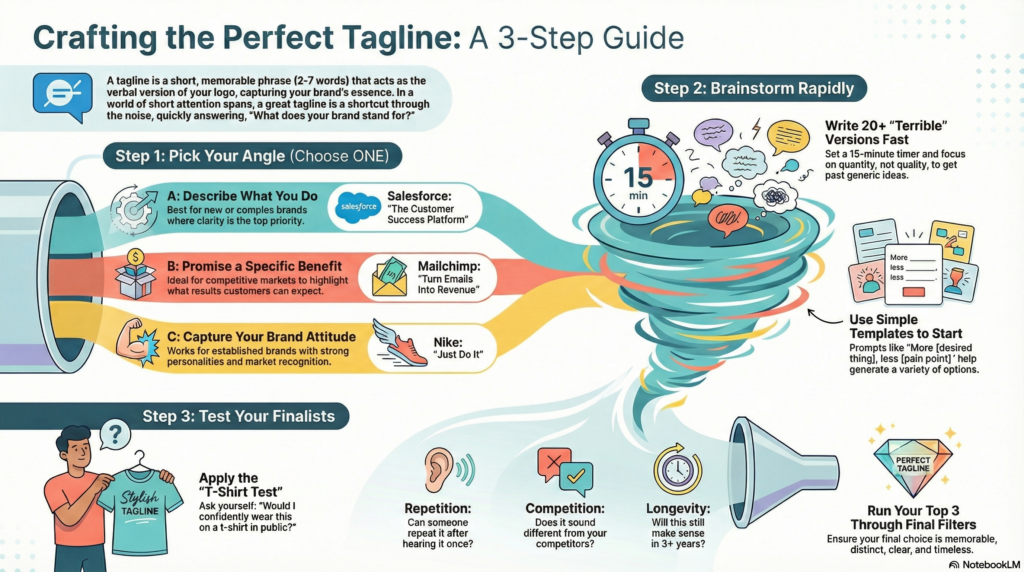
Writing a tagline doesn’t require a brand workshop or expensive agency. It requires clarity about what you do and who you serve. Here’s the practical process that actually works.
Step 1: Pick Your Angle (Choose ONE)
Your tagline needs to accomplish exactly one job. When you try to do everything, you end up memorable at nothing.
Option A: Describe What You Do
Best for: New brands, complex products, B2B companies where clarity beats creativity every time.
The formula: [What you are] + [Key differentiator]
Examples:
“Where Work Happens” (Slack)
“The Customer Success Platform” (Salesforce)
“Project Management for Modern Teams” (Asana-style)
Option B: Promise a Specific Benefit
Best for: Competitive markets where you need results-focused differentiation to stand out.
The formula: [Desired outcome] + [How you’re different]
Examples:
“Turn Emails Into Revenue” (Mailchimp)
“Expect More. Pay Less.” (Target)
“The Simpler, Safer Way to Pay” (PayPal)
Option C: Capture Your Brand Attitude
Best for: Brands with strong personality and established category understanding.
The formula: [Aspirational statement] + [Your unique voice]
Examples:
“Think Different” (Apple)
“Just Do It” (Nike)
“Live Más” (Taco Bell)
Pick ONE angle. When you mix them, you create mush like “Innovative Solutions Empowering Your Success Through Cloud-Based Excellence.” Nobody remembers that garbage.
Step 2: Write 20 Terrible Versions Fast
This is the part everyone skips, and it’s why most taglines fail.
Your first tagline will be generic. Your fifth will still be boring. By number 15, you’re getting warmer. This isn’t a quality problem. It’s a volume problem. You need to get the bad ideas out of your system before you find the good ones.
Set a timer for 15 minutes and fill in these templates:
For “What You Do” taglines:
“The [superlative] way to [specific action]”
“[Category] for [specific audience]”
“[Action verb] [specific outcome]”
For “Benefit” taglines:
“More [desired thing], less [pain point]”
“[Benefit] without [common objection]”
“[Outcome] in [timeframe or context]”
For “Attitude” taglines:
“[Short command]”
“[Aspirational state]”
“[Make/Do/Be] + [noun]”
Example brainstorm for an online course platform:
- “The complete course creation platform”
- “Build courses people finish”
- “Course creation made simple”
- “More students, less tech headaches”
- “Teaching tools that actually work”
- “Create. Launch. Teach.”
- “Online teaching simplified”
- “The creator’s classroom”
- “Course building for real teachers”
- “Turn expertise into income”
- “Make knowledge profitable”
- “Share what you know”
- “Your expertise, their transformation”
- “Teach anything to anyone”
- “Where experts become teachers”
- “The teaching platform teachers love”
- “Build once. Teach forever.”
- “Courses that convert”
- “Create impact at scale”
- “Your knowledge, delivered”
Notice how different these are? That’s the whole point. You need variety to find the winner hiding in there.
Step 3: Apply the T-Shirt Test
Take your top 5 options and ask yourself this: Would I wear this on a t-shirt in public?
I’m serious. If it feels awkward on a shirt, it’ll feel awkward everywhere else.
Great taglines pass this test because they’re:
Short enough to read at a glance (2-7 words ideal)
Clear enough that strangers get it (no jargon or inside jokes)
Confident enough you’d stand behind it (no hedging like “We try to…” or “Helping to…”)
Then run the final 3 through these filters:
The Repetition Test: Can someone repeat it back after hearing it once?
If not, it’s too complex or unmemorable.
The Competition Test: Does it sound different from your competitors?
If not, it’s too generic. Keep going.
The Clarity Test: Does it help people understand what you do or why they’d care?
If not, it’s too vague or clever for clever’s sake.
The Longevity Test: Will this still make sense in 3 years?
If not, it’s too trendy or tied to current campaigns.
The Reality Check
Don’t obsess over perfection. Your tagline isn’t carved in stone and mounted on the side of a building.
Nike’s original tagline wasn’t “Just Do It.” It was “There is no finish line.” McDonald’s has changed theirs multiple times. Brands evolve, and taglines evolve with them.
Start with clarity. Start with something you can actually use tomorrow. You can always refine it later when you have more data on what actually resonates with your audience.
The goal isn’t to create the perfect tagline. The goal is to create a memorable one that accurately represents what you stand for right now. Perfect comes later, if ever.
Tagline vs. Slogan: What’s the Difference?
People mix these up all the time. Here’s the simple breakdown.
Tagline = Your Brand’s Permanent Identity
A tagline is your brand’s verbal signature. It shows up next to your logo, on your website, in your email footer. Everywhere your brand name shows up. Taglines are built for the long haul.
Purpose: Define who you are as a brand
Lifespan: Years, sometimes decades
Scope: Your entire brand
Example: Apple’s “Think Different” or BMW’s “The Ultimate Driving Machine”
Slogan = Your Campaign’s Temporary Hook
A slogan gets created for a specific marketing campaign, product launch, or promotion. When the campaign ends, the slogan usually goes away too.
Purpose: Sell a specific product or promote a campaign
Lifespan: Weeks to months
Scope: Single campaign or product line
Example: Wendy’s “Where’s the Beef?” or Budweiser’s “Whassup?”
Side-by-Side Comparison
| Aspect | Tagline | Slogan |
| Duration | Permanent (years) | Temporary (campaign length) |
| Purpose | Define brand identity | Drive specific action |
| Changes | Rarely | Frequently |
| Appears with | Logo and brand name | Ads and promotions |
| Example | Nike: “Just Do It” | Nike: “Find Your Greatness” (2012 Olympics campaign) |
The Confusing Part: Sometimes Slogans Become Taglines
McDonald’s “I’m Lovin’ It” started as a campaign slogan back in 2003. It worked so well they made it their permanent tagline. Same thing happened with Verizon’s “Can You Hear Me Now?” Started as a campaign slogan, became the brand tagline.
Do You Need Both?
If you’re a small business or startup: Focus on the tagline first.
Your tagline is your foundation. Once you’ve got that locked down, you can create campaign-specific slogans for promotions, product launches, or seasonal marketing when you need them.
Big brands use both because they have marketing teams and budgets to support that complexity. You probably don’t need to complicate things until you’re at that scale.
Quick Decision Framework
Ask yourself: “Will this phrase still make sense in 2 years?”
Yes = It’s probably a tagline
No = It’s likely a campaign slogan
If changing it next quarter would be weird or confusing for customers, that’s your tagline. Protect it.
Frequently Asked Questions About Taglines
How long should a tagline be?
Most successful taglines are between 2 and 7 words. The sweet spot is usually 3 to 5 words.
“Just Do It” is three words. “The Ultimate Driving Machine” is four.
You can go longer if it’s genuinely memorable. Mastercard’s famous line is 16 words. But shorter is almost always better.
Here’s the real test: if you can’t say it in one breath, it’s too long.
Do I really need a tagline?
Depends on your brand name and what market you’re in.
You probably don’t need one if:
Your brand name clearly describes what you do (like “New York Pizza Co.” or “Budget Car Rental”)
You’re in a very niche B2B market where everyone already understands your category
You’re a personal brand where your name IS the brand
You definitely need one if:
Your brand name is abstract or doesn’t explain what you do
You’re in a crowded, competitive market
You need to clarify your positioning quickly
You want to stand out from similar competitors
Think of your tagline as your elevator pitch compressed to 5 words. If you need that clarity, create the tagline.
Can I change my tagline later?
Yes. Brands evolve, and taglines should too.
Pepsi has changed theirs multiple times. Google moved on from “Don’t Be Evil.” Coca-Cola has had dozens of taglines since 1886.
When to update your tagline:
Your business model changes significantly
Your target audience shifts
Your current tagline feels outdated or off-brand
You’re going through a major rebrand
When NOT to change it:
You’re just bored with it (your customers aren’t as familiar with it as you think)
Competitors are copying it (that actually means it’s working)
It’s only been a few months (give it time to build recognition)
Good rule of thumb: if your business’s core value proposition stays the same, your tagline should probably stay too.
What makes a tagline memorable?
Three things: rhythm, simplicity, and specificity.
Rhythm: The best taglines have a natural cadence that makes them easy to say. “Just Do It” rolls off the tongue. “Think Different” sounds distinct. Read your tagline out loud. Does it flow naturally?
Simplicity: Use everyday words, not business jargon. Compare “Innovative solutions for dynamic enterprises” (completely forgettable) vs. “Just Do It” (iconic). Simple wins every time.
Specificity: Include at least one concrete detail. “America Runs on Dunkin’” is specific to coffee as fuel. “The Ultimate Driving Machine” is specific to the driving experience, not just generic “luxury cars.”
Bonus ingredient: Emotion. The most memorable taglines make you feel something. Motivation, happiness, confidence, aspiration. Something.
Should my tagline describe what I do or how I make people feel?
Start with what you do if you’re new or in a complex industry. Lead with emotion if you’re established or in a commodity market.
New SaaS company? Go with “Project management that actually gets used” (what you do plus a differentiator).
Established beverage brand? Use something like “Open Happiness” (pure emotion).
The progression usually goes like this: Clarity, then Differentiation, then Emotion.
Don’t skip straight to emotion if people don’t understand your basic function yet.
Coca-Cola earned the right to “Open Happiness” after a century of people knowing they sell soda. You probably haven’t earned that yet.
What if my tagline is similar to a competitor’s?
If it’s too similar, change it. You’re not building distinctiveness. You’re creating confusion and helping your competitor.
Quick audit: Google your potential tagline in quotes. If competitors appear in the results, that’s a red flag.
How to fix it:
* Add specificity that relates to YOUR unique approach
* Choose a different angle (benefit vs. description vs. attitude)
* Use your brand voice to make it sound distinctly different
Remember: your tagline’s whole job is to differentiate you, not blend you in with the crowd.
Can I use my tagline in my logo?
You can, but you don’t have to.
Some brands integrate their tagline into their logo design (like “Intel Inside”). Others keep them completely separate.
Best practice: Keep them separate in your core logo file. This gives you flexibility to use the tagline in some contexts but not others. Like tiny social media avatars where the tagline would be completely unreadable.
That said, your tagline should appear prominently WITH your logo on major touchpoints. Your website header, business cards, and email signatures for sure.
Making Your Tagline Work (Not Just Writing It)
Here’s what nobody tells you about taglines: they’re worthless if people don’t actually see them.
You can spend weeks crafting the perfect 5-word phrase. But if it only lives in your website footer where 90% of visitors never scroll, you’re wasting its potential completely.
Your tagline needs to show up in the right places at the right moments:
High-Impact Placement Areas:
Website hero section (above the fold where people actually look)
Homepage popups or welcome messages when visitors first land
Exit-intent popups when people are about to leave your site
Email signatures from your entire team
Social media bios and cover images
Business cards and printed materials
Video intros and outros
The key is strategic visibility. Your tagline should reinforce your brand message at critical decision points. Especially those micro-moments when visitors are deciding whether to engage with you or bounce to a competitor.
This is where conversion tools actually earn their keep. At BDOW!, we help brands put their best messaging (taglines, value props, offers) in front of visitors at exactly the right moment. Not annoying spam popups that make people hate you. Strategic, well-timed messages that actually add value and feel helpful.
Think of it this way: your tagline is your opening line. Conversion tools make sure the right people actually hear it. When you combine clear messaging with smart delivery, you’re not just getting more leads. You’re getting leads who already understand what you’re about before they even fill out a form.
The best tagline in the world can’t help you if it’s invisible. Make it seen.
How We Chose BDOW’s Tagline: A Real Example
Since we’re talking about taglines, let’s break down how we arrived at BDOW’s current tagline: “Your Website’s Conversion Engine.”
This wasn’t our first idea. Or our fifth. We went through the same process we’re recommending to you, and here’s why we landed where we did.
What We Needed to Communicate
BDOW does a lot of things. We’ve got popups, lead capture forms, social proof notifications, advanced targeting, exit-intent triggers, and a bunch of other features. But listing features makes for a terrible tagline. Nobody cares about your feature list. They care about what those features do for them.
We needed to distill everything down to the core benefit: we help websites convert more visitors into leads and customers.
Why “Your Website’s Conversion Engine” Works
It’s functional and clear. You immediately understand that we’re about conversion. Not traffic generation. Not design. Conversion. If that’s what you need, you’re in the right place. If it’s not, you can move on without wasting time.
The “engine” metaphor does heavy lifting. An engine is what powers something. It’s essential infrastructure, not a nice-to-have accessory. It’s the thing that makes the whole system actually work. That’s exactly how we want people to think about conversion tools. Not as optional add-ons, but as the core system that turns your website traffic into actual business results.
It positions us correctly. We’re not just a popup tool. We’re not just a lead capture form. We’re the entire system that powers conversion on your site. The tagline gives us room to grow and add features without outgrowing our positioning.
It’s about the customer, not us. Notice it says “Your Website’s Conversion Engine,” not “The Conversion Engine” or “BDOW’s Conversion Engine.” It’s immediately about your business and your website. That subtle word choice matters.
How It Connects to What We Actually Do
Here’s the reality behind the tagline:
We generate leads. Those leads are fuel for your business. Without consistent lead generation, your business stalls. Just like an engine needs fuel to run, your business needs leads to grow. Our tools (popups, welcome mats, scroll boxes) capture emails at strategic moments when visitors are most engaged.
We help convert those leads. Lead capture is just the start. We provide social proof tools that show recent signups and purchases, building trust with new visitors. We offer advanced targeting so you show the right message to the right person at the right time. We give you exit-intent technology that recovers visitors who are about to leave. All of this increases the percentage of visitors who actually become customers.
We create a system, not just individual tools. The “engine” part is key here. An engine isn’t one part. It’s a system of components working together. That’s how our platform works. The popup captures the email. The social proof builds credibility. The targeting ensures relevance. The exit-intent recovers abandoning visitors. Together, they create a conversion system that actually performs.
The Process We Used
We started with about 15 different options:
“Turn Visitors Into Customers”
“The Popup Platform That Converts”
“Conversion Tools for Smart Businesses”
“Your Website’s Growth Engine”
“Make Every Visitor Count”
“Conversion Made Simple”
“The Lead Generation Platform”
We kept coming back to the “engine” metaphor because it captured both the systematic nature of what we do and the essential, foundational role conversion plays in any online business.
We tested “Growth Engine” vs. “Conversion Engine.” Growth felt too vague. What kind of growth? Traffic growth? Revenue growth? Team growth? Conversion was more specific and accurate to what we actually deliver.
What This Means for Your Tagline
The lesson here isn’t to copy our tagline structure. It’s to go through the same thinking process:
What’s your core benefit? (Not features, benefit)
What metaphor or concept captures that benefit clearly?
Does it position you correctly for where you want to go, not just where you are today?
Is it about your customer or about you?
Your tagline should do what ours does: immediately tell someone whether they’re in the right place, position your offering correctly in their mind, and give you room to grow without outgrowing your own positioning.
That’s how you create a tagline that actually works for your business.
Your Tagline Is Your Brand’s Shorthand
A great tagline won’t save a mediocre product. But it will give a great product the memorable first impression it deserves.
Your tagline is what people say when they recommend you to a friend. It’s what sticks when they’re comparing you to three other options. It’s the verbal shortcut to everything your brand represents.
Most businesses overthink this entire process. They hire expensive agencies or workshop it endlessly, trying to create something “perfect.” That’s fine if you have the budget and timeline to support it. But it’s not necessary for most businesses.
The best taglines come from clarity, not complexity. Know who you’re for. Know what you promise them. Write 20 versions without overthinking it. Pick the one that passes the t-shirt test.
Then (and this is the part that actually matters) use it. Put it where people can see it. Test it in your messaging. See if it resonates with your actual audience. Adjust if you need to.
Your tagline isn’t static. It can evolve as your brand grows and changes. What matters is having one that works right now. Something clear, memorable, and true to what you actually deliver.
Stop overthinking it. Start testing it.
Because a tagline nobody sees is just words in a brand guidelines document collecting digital dust. Get it out into the world and see what happens.




Add A Comment
VIEW THE COMMENTS