A welcome email is the first email you send a new subscriber, fired off the second they join your list.
And because they just raised their hand and asked to hear from you, it gets opened and clicked more than almost anything else you’ll ever send. Klaviyo’s 2026 data pegs the average welcome email at around $2.35 in revenue per recipient. On a list of 10,000 people, that’s not a rounding error.
Here’s the catch most people miss.
That kind of attention has a shelf life. The subscriber is most interested in you about four seconds after they hit subscribe, and a little less interested every hour after that. So the welcome email isn’t the moment to play it safe with a logo and a “thanks for joining.”
In this post you’ll get five welcome email examples that actually do something: build rapport, train inboxes to like you, surface what your audience actually wants, and yes, make sales. Then I’ll show you how to stop thinking about one welcome email and start thinking about a welcome series, which is where the real money hides.
Table of Contents
First, one rule that makes all five examples work
Every welcome email should have exactly one job.
Not three. One.
The fastest way to waste that first-email attention is to cram in everything at once. Read our latest posts! Follow us on six platforms! Here’s our founder’s life story! Buy this! The reader skims, gets overwhelmed, picks nothing, and closes the tab.
Pick a single goal instead. There are really only three:
- Content consumption (get them reading or watching)
- Email engagement (get them replying, whitelisting, or telling you something)
- Product sales (get them buying)
Each of the five examples below is built around one of those goals. And here’s the part competitors bury at the bottom of their posts: you don’t have to choose just one forever. You choose one per email, then chain a few emails together into a series. More on that after the examples.
Example #1: Send your most popular content
Goal: Content consumption.
Best for: Content creators, newsletter writers, personal brands.
Nobody wants a 3,000-word welcome email explaining why they should care about your emails.
Here’s a rule of thumb: never waste the reader’s time. If you can make your point in two minutes, make it in two minutes.
A great content-first welcome email does two simple things. It hands the new subscriber two or three of your best pieces (your greatest hits, basically), and it tells them where else to find you, like your podcast or YouTube channel.
That’s it. Short, casual, written like a text from a friend instead of a press release.
The reason this works is rapport. Your best content already convinced someone, somewhere, to stick around. Putting it in front of a brand-new subscriber gives them the same reason to stick around, on day one.
Key takeaway: Keep it short and human. Hand new subscribers your two or three best pieces of content to build rapport fast and set the tone for everything that follows.
Example #2: Get subscribers to reply (and whitelist you)
Goal: Email engagement.
Best for: Everyone who relies on email at all.
Your emails only work if they actually land in the inbox. Not the Promotions tab. Not Updates. And definitely not the spam folder.
The single best time to fix that is right now, in the welcome email, while the subscriber is paying attention and likes you.
So ask them to do one tiny thing: reply to the email, or add your address to their contacts. A reply is the strongest signal you can send an inbox provider that says “this person is wanted here.” Whitelisting does the same job.
Why now and not later? Because asking a brand-new subscriber for a small favor is easy. They’re expecting your email. They’re glad it showed up. Ask them the same thing eight weeks from now and you’ll get crickets.
Key takeaway: The first email is the best time to ask for a reply or a whitelist, because that one small action trains the inbox to deliver every future email straight to Primary.
Example #3: Ask one question to find their pain points
Goal: Email engagement.
Best for: Creators, freelancers, service-based businesses.
Business is mostly just solving a problem people will pay you to solve. Which raises an annoying question: how do you know which problem?
The shortcut is to stop guessing and ask.
Add one simple question to your welcome email. Something like, “What’s the one thing you’re trying to figure out right now?” Then let people tell you, in their own words.
Two things happen. First, you get a reply, which (see Example #2) is great for deliverability. Second, you get a folder full of your audience describing their problems in their own language, which is content gold, product gold, and subject-line gold all at once.
You stop writing what you think they need and start writing back the exact words they used.
Key takeaway: Ask new subscribers one question about what they’re struggling with. You get better deliverability, better content ideas, and a subscriber who feels like you actually care. Because you do.
Example #4: Deliver a welcome discount
Goal: Product sales.
Best for: Ecommerce stores.
If you run a store and you’re not ready to commit to a full content-marketing operation, no judgment. Content takes forever and the payoff doesn’t show up overnight.
There’s a faster trade you can offer instead: a discount in exchange for an email address.
Set up an email capture form that offers a first-order discount to new visitors. The second someone signs up, your welcome email shows up with the code you promised, while they’re still in shopping mode.
This is the most direct version of “deliver what you promised.” They gave you an email for a discount. You give them the discount. They buy. Everybody’s happy, and you grew your list and made a sale in the same motion.
If discounts aren’t your style, the same slot works for a free lead magnet or a content upgrade instead. The principle is identical: deliver the promised thing immediately.
Key takeaway: Promise a discount at signup, then deliver the code in the welcome email while purchase intent is still hot. Quick to set up, and it grows your list and revenue at the same time.
Example #5: Feature your bestsellers
Goal: Product sales.
Best for: Ecommerce stores, digital product makers.
Walk into a good retail store and the “most popular” stuff is right by the door for a reason.
Your welcome email is the door.
A discount gets someone interested. The problem is, “interested” people still freeze when they hit a store with 400 products and no idea where to start. So don’t make them start from scratch. Show them your three or four bestsellers right in the welcome email, with a button straight to each one.
You’re removing a decision, not adding one. Instead of “go explore the whole catalog and good luck,” it’s “here’s what everybody else loves, start here.”
This pairs perfectly with Example #4. Discount in the first email, bestsellers in the next. Which is a pretty good segue, actually.
Key takeaway: People who like you still don’t always know what to buy. Feature your bestsellers in the welcome email to remove the decision paralysis and point them at a clear first purchase.
How to turn these five into a welcome series
Here’s the shift that separates a decent welcome email from a welcome email that quietly makes money.
Stop thinking about one email. Think about three or four, sent automatically, each doing one job.
A single welcome email forces you to pick one goal and abandon the rest. A welcome series lets you do all of them, one at a time, without overwhelming anyone. And automated flows like this consistently out-earn your regular broadcasts, because they hit people at the exact moment they’re paying attention.
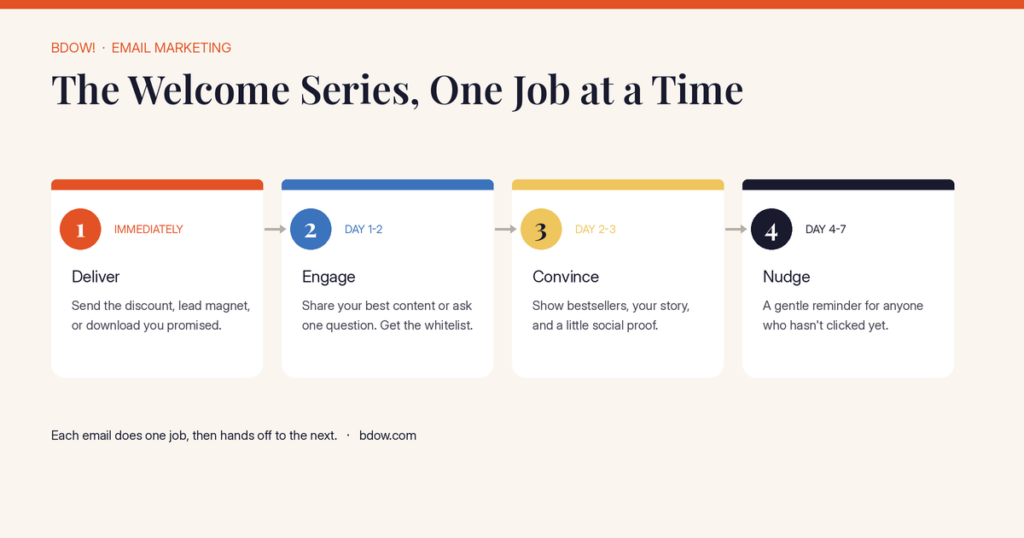
You don’t need anything fancy. A solid starter series is three to four emails:
- Email 1 (send immediately): Deliver what you promised. The discount code, the lead magnet, the download. Whatever got them to sign up. Send it within minutes, not hours. Their attention will never be higher than it is right now.
- Email 2 (day 1 or 2): Build the relationship. Your best content (Example #1) or the one-question ask (Example #3). This is where you stop being “a brand they gave an email to” and start being someone they actually read.
- Email 3 (day 2 or 3): Make the case. Your bestsellers (Example #5), your story, your social proof. Show them why people stick around and buy.
- Email 4 (optional, day 4 to 7): Nudge. A gentle reminder for anyone who hasn’t clicked or bought yet. No pressure, just a second open door.
Notice that Email 2 has a whitelist or reply ask baked in (Example #2) no matter what. That one little action protects every email that comes after it.
That’s the whole trick. You’re not writing five separate emails that compete with each other. You’re writing one sequence where each email has a single job and hands off cleanly to the next.
The unglamorous part: you need the email address first
All of this assumes one thing. That you’re actually collecting email addresses in the first place.
A welcome series has nothing to welcome if visitors leave your site without signing up. And most of them do, unless you give them a clear, well-timed reason to stay.
That’s the boring, load-bearing part of the whole operation. A good signup form or popup, offering something worth an email address, shown at the right moment. Pair it with a lead magnet people actually want, add a little social proof so they trust the exchange, and your welcome series suddenly has a steady stream of people to welcome.
That’s the whole point of BDOW! We help you capture the email so the welcome series you just planned actually has someone to send to. Funny how that works.
Want help building the machine that feeds all this?
Welcome emails are step two. Step one is getting the signup in the first place, and that’s exactly what we walk through in our free masterclass.
The Lead Magnet Playbook shows you how to turn your website from a place people visit into a machine that actually captures leads, the ones your welcome series then turns into customers.




Add A Comment
VIEW THE COMMENTS